

China’s Fiscal Revenue Falls for the First Time in Five Years
[People News] China’s economy continues to “create miracles,” with officially reported GDP growth consistently holding at 5%, astonishing the world. The official data shows resilience, yet people on the ground feel as if they are stuck in a bitter winter. This stark contrast, in the Party’s words, is not an economic cover-up but “developmental tension,” not structural failure but “institutional superiority.”
Of the “three engines” driving the economy, exports rank first. Cai Qi’s ever-optimistic economic propaganda counts as another. In addition, Party leader Xi Jinping’s personal directives—and personal outrage—have “pointed the way” for economic development. Economic recovery is said to be steady and improving; the furious ruler’s “rage economics” has become a mega-engine, contributing the most and taking the greatest credit.
According to a recent Wall Street Journal report, Xi said in 2020 that by 2035 China would double both its total economic output and per capita income. To reach that goal, China must maintain average annual growth of about 4.7% to 5%, leaving very little room for error.
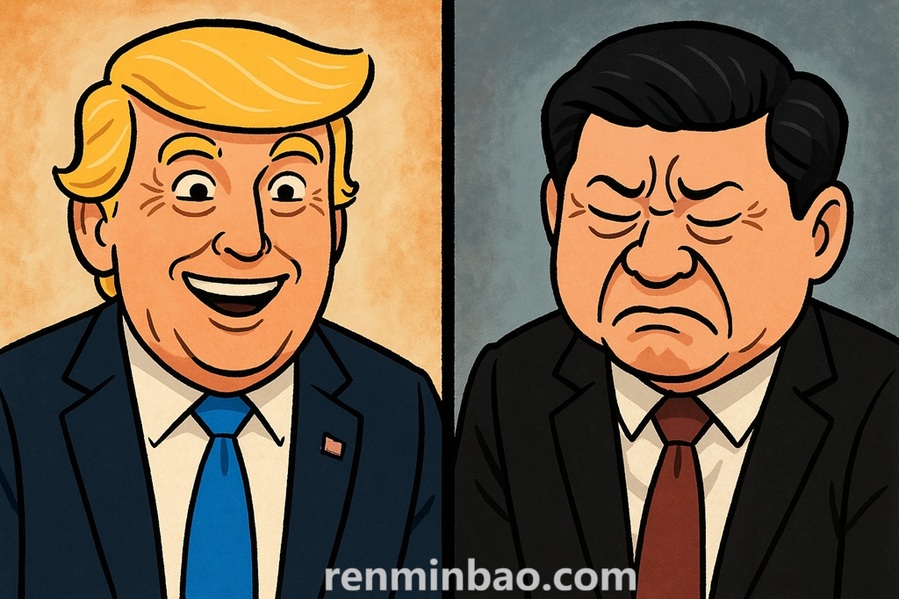
By late 2024, the stakes of that target reached a peak. Provincial data had been gloomy for months. Consumption was weak, housing prices plunged, and the middle class was slipping downward. That year, achieving 5% growth looked doubtful, and failure would be seen as directly conflicting with the 2035 vision. When the “raw data” reached Zhongnanhai, Xi reportedly flew into a rage. The result was a “September surprise” — a sudden wave of stimulus measures, interest rate cuts, and stock market rescue actions.
Although Xi holds supreme power, nearly the entire bureaucracy survives by telling him pleasant lies, reporting only good news and catering to his preferences. In the promotion system for local officials, local GDP plays a decisive role. In China’s political ecosystem, Xi’s anger is a seismic warning signal in officialdom. Numbers produce officials, and officials produce numbers — data is directly tied to one’s political hat. Seasoned officials understand this perfectly.
Thus, falsifying economic data has long been a go-to tactic for local officials to boost performance records. Even China’s much-vaunted export data has been engineered by local authorities. Yicai reported late last year that in many places, fraudulent “invoice-only exports” had become common. With tacit or even direct government support, shell companies purchased fake “export data” from customs brokers. Local governments then issued rewards based on customs statistics, artificially inflating export figures.
As China’s economy keeps slowing and consumption weakens, the financial data reflects falling loan numbers. To patch this gap, the financial system has fabricated loans. Loan officers find companies willing to “borrow” on paper, with the bank itself covering the interest. Large state-owned banks have essentially copied the online shopping trick of fake orders to boost sales figures.
According to Caixin, in the second half of 2025 China’s central bank inspected data submitted by financial institutions and found that one of the three major policy banks, the Agricultural Development Bank of China, had overstated agricultural loans by about 2 trillion yuan — fully 25% of its total agricultural loan portfolio. Xi was reportedly furious and had Wu Biao, former director of the bank’s Policy Research Office, detained. On February 7, the Central Commission for Discipline Inspection announced that Xu Yiding, vice president of the bank, was under investigation. Whether this is directly linked to the fake loans is unclear, but financial data inflation appears to be routine KPI practice for executives.
One puzzling question remains: what were the “raw data” mentioned by the Wall Street Journal that angered Xi? Do local officials really maintain two data systems — one with real figures and another with beautified numbers? Anyone familiar with the inner workings of the system knows it is not that simple.
The so-called “raw data” were most likely already polished local statistics. That even these beautified numbers enraged Xi suggests just how severe the real economic downturn must be.
Official GDP data for 2025 met Xi’s desired 5% target. But falsehoods cannot hide reality. The National Bureau of Statistics’ GDP numbers were contradicted by Ministry of Finance data: on January 30, the ministry reported that fiscal revenue for 2025 fell 1.7% year-on-year — the first annual decline in five years. Central government revenue dropped even more sharply, down 6.5%. Over the past decade, except for 2020 during COVID shutdowns, central revenue had almost always grown. This highly unusual reversal signals that China’s economy has reached an unprecedented crisis point.
On February 6, Singapore’s Lianhe Zaobao analyzed three “counterintuitive” aspects of China’s fiscal data:
The main reason for declining central fiscal revenue was an 11.3% drop in non-tax revenue. The official explanation was that from 2022 to 2024, certain state financial institutions and monopolies were forced to remit extra profits, inflating the base. After years of “bloodletting,” they had little left to remit in 2025.
However, economist Lu Ting noted this doesn’t explain everything. December declines were seen in both tax and non-tax income, indicating falling corporate profits and weaker economic activity overall.
While overall tax revenue grew only 0.8%, personal income tax surged. With most people feeling poorer, why did income tax outpace GDP? The answer lies in stricter enforcement — effectively intensified targeting of high-net-worth individuals.
2025 was dubbed the “first year of global taxation” for the wealthy, as CRS data-sharing exposed offshore assets. Meanwhile, tax authorities began receiving full data from internet platforms, triggering a year-end wave of back-tax collections from influencers and online sellers. In the first 11 months alone, 1,818 high-income individuals were investigated, recovering 1.523 billion yuan in taxes.
By contrast, VAT rose only 3.4% and corporate income tax just 1%, better indicators of real economic health.
Local budget revenue grew 2.4%, seemingly better than the center. But land-sale revenue fell 14.7% to 4.15 trillion yuan, less than half its 2021 peak. Land finance — selling land to fund infrastructure and stimulate property — was the core engine of local government finance for two decades. With the property market collapsing, that model has broken down.
So where did local revenue growth come from?
Governments sold more public assets: idle office buildings, cafeteria operating rights, roadside parking concessions, and even long-term tourism revenue rights. These one-off sales were counted as non-tax revenue.
Remember the Qiqihar case? In 2025, mud from two reservoirs was “sold” for 800 million yuan through internal transfers, with the debt ending up on bank balance sheets — and the public paying in the end.
“Revitalizing state assets” is really borrowing from the future. Hubei even promoted a model of “asset-ization, securitization, and leveraging of all state assets,” essentially financializing government depletion. Officials preach “tight belts,” while tightening citizens’ belts instead.
In the end, the government’s solution to mounting debt is simply printing money and raising taxes — pushing both rich and poor into shared poverty.
(People News)






News magazine bootstrap themes!
I like this themes, fast loading and look profesional
Thank you Carlos!
You're welcome!
Please support me with give positive rating!
Yes Sure!