
CCP Issues Banned Terms
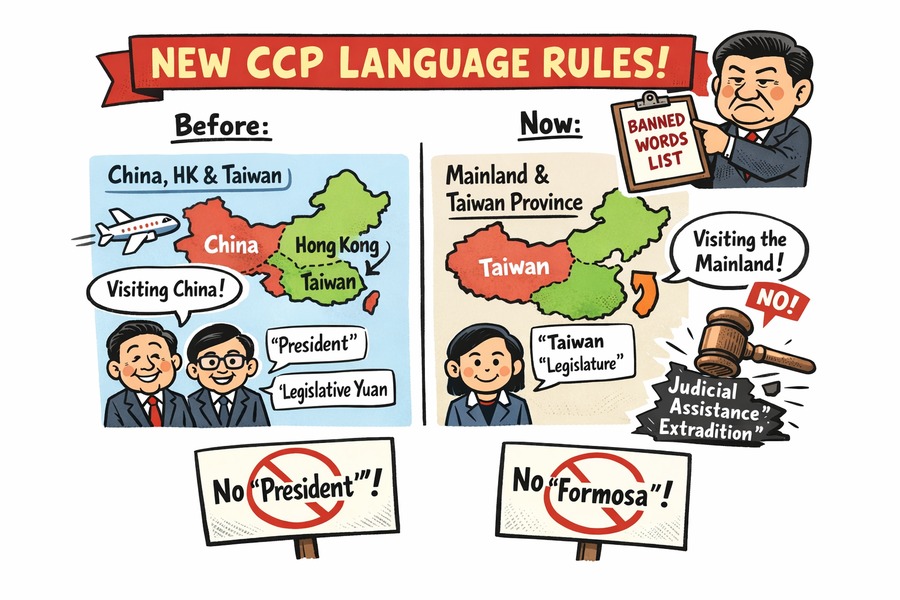
[People News] In the CCP’s political world, language has never been merely a tool of communication—it is also a series of invisible red lines. On February 27, the state-run news agency Xinhua published its latest list of “prohibited terms in news reporting.” The Taiwan-related section alone contains dozens of provisions, covering social life, legal terminology, territorial sovereignty, and cross–Hong Kong–Macau–Taiwan relations.
Let’s first look at the most sensitive category: “territorial sovereignty.” This time, Xinhua added 13 new prohibitions specifically targeting Hong Kong, Macau, and Taiwan. The core directive is clear: Taiwan is a province of China, and under no circumstances may it be referred to as a “country” in any text, map, or chart.
A more subtle shift lies in the mandatory use of “corresponding concepts.” Expressions such as “cross-strait and three regions” or “China–Taiwan,” which imply parallel or equal status, are now forbidden. Officials require that “Taiwan” be paired with “the motherland mainland,” and “Hong Kong and Macau” be paired with “the mainland.” Any confusion or parallel framing is deemed a political error. Even tourism language is regulated—visitors may no longer be described as “traveling to China,” but must instead say “traveling to the mainland” or “traveling to the interior.”
How does the official line handle Taiwan’s existing governmental operations? Xinhua adopts what might be called a “quotation mark strategy.” If Taiwan’s institutional names cannot be avoided—such as the “Legislative Yuan,” “Executive Yuan,” or “Election Commission”—they must be placed in quotation marks.
The restrictions are even stricter for institutions bearing the words “Central” or “National.” Entities such as Taiwan’s “Central Bank” or “National Tsing Hua University” must also appear in quotation marks. The most absolute red line is the prohibition on using the titles “President of the Republic of China” or “Vice President” to refer to Taiwan’s leaders. Officials emphasize that even quotation marks do not make such usage acceptable. In textual terms, this effectively erases symbols of Taiwan’s sovereignty.
This “de-sovereignization” approach also extends into the legal sphere. The new rules require that laws implemented in Taiwan be described as “relevant regulations of the Taiwan region.” In handling cross-strait legal matters, international law terms such as “judicial assistance” or “extradition” are strictly prohibited, because under the official framework, these are considered “domestic affairs,” not matters between two states. Even the historical name “Formosa” is now banned, except when directly quoting others.



News magazine bootstrap themes!
I like this themes, fast loading and look profesional
Thank you Carlos!
You're welcome!
Please support me with give positive rating!
Yes Sure!