

A Russian reporter’s single question nailed Xi to the pillar of shame. (Screenshot from X platform)
[People News] On March 9, at the Ministry of Foreign Affairs’ regular press conference, the question posed by Alina, RT’s correspondent in China, was like a precise scalpel cutting straight into the most sensitive nerve of Sino-Russian relations.
She almost word for word repeated Estonian Foreign Minister Margus Tsahkna’s internationally sensational harsh remark on March 5: “Putin’s friends are either in heaven, or in hell (most likely in hell), or in prison. Only a very few are left, such as North Korea and China.” Then she calmly asked: “What is China’s comment on this?”
This question can be called god-tier.
On the surface, it seemed to be using Russia’s hand to kill with another’s knife, but in reality it pushed China into a corner with no good way forward or back: either publicly deny that it is one of “Putin’s only remaining lonely friends,” or tacitly accept being grouped by the West together with North Korea as “the next object waiting to be removed.” Either way, it was extremely embarrassing.
More fatally, Alina’s question was not groundless. It accurately captured the real cracks quietly emerging in Sino-Russian relations.
In recent years, Beijing’s position on the Ukraine issue has no longer been a monolithic “neutrality.” Although officials still insist that they do not provide lethal weapons, Western and Ukrainian intelligence have repeatedly pointed out that China has, through third-party channels, provided Russia’s military industry with dual-use goods, machine tools, electronic components, and even chemicals, objectively sustaining Russia’s continued war effort. At the same time, recent rumors indicate that China has also quietly provided forms of aid such as energy to Ukraine through third parties — which, in Moscow’s eyes, is no different from “betting on both sides.” Russian domestic opinion has long been full of dissatisfaction with this, believing that the so-called “no-limits partnership” is merely a convenient tool for China to balance pressure from the U.S. and Europe, and that once its strategic needs change, Beijing can withdraw at any time.
One question nailed Xi to the pillar of shame
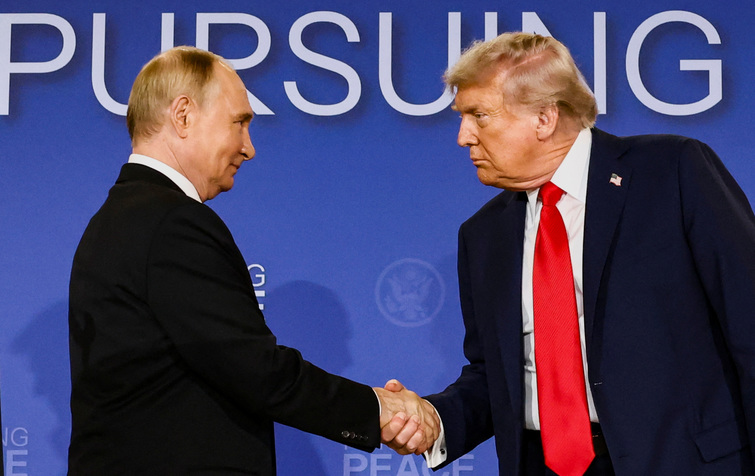
Putin’s own remarks after the Alaska summit in August 2025 made this crack fully visible. Putin publicly signaled his willingness to accept security guarantees from the United States and Europe for Ukraine similar to NATO Article 5, and even hinted that he could reach a new agreement with the U.S. on nuclear issues. This runs completely counter to China’s long-term position of “opposing NATO expansion eastward” and “opposing bloc confrontation.” In order to get out of the war quagmire as quickly as possible, Moscow was willing to compromise with Washington on its core security red lines, while leaving Beijing in an extremely passive position — you keep talking about “no limits,” yet when I negotiate terms with the United States, you do not even have the right to know?
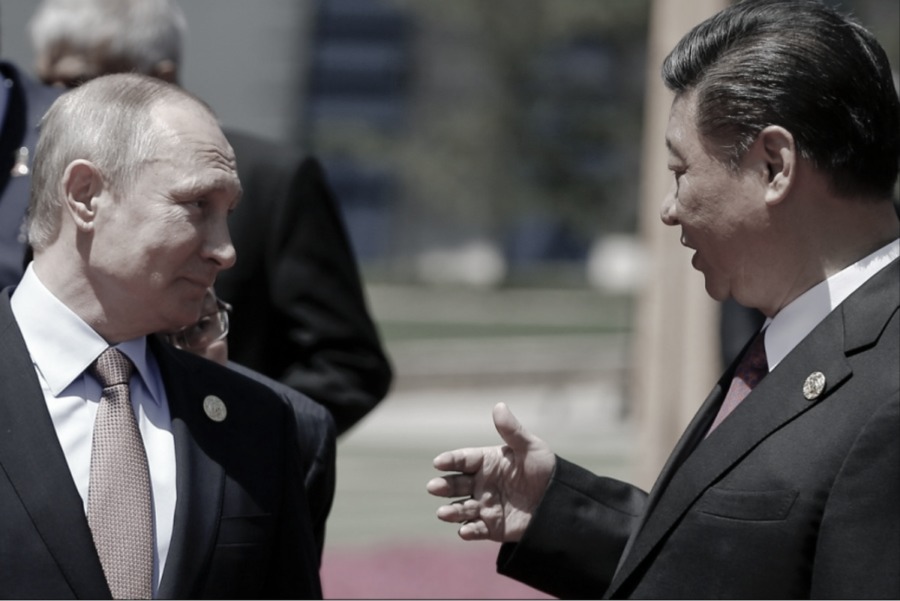
Alina’s question magnified this awkwardness tenfold. Borrowing the words of the Estonian foreign minister, she placed Xi Jinping and Kim Jong Un side by side as “Putin’s only remaining few friends.” In essence, she was mocking: the friends Putin makes either die violently, go to prison, or are lonely dictators without companions. This was not just an insult to Putin’s character; it directly nailed Xi Jinping to the pillar of shame as one of “Putin’s only two remaining lonely friends.”
On a deeper level, this question also indirectly reflected the real attitude within Russian domestic opinion toward “unlimited Sino-Russian cooperation.” The fact that an RT reporter could ask such a sharp question at a Beijing press conference in itself shows that the Kremlin can no longer fully control the narrative — more and more people in Russia’s public and elite circles believe that China is merely using Russia as cannon fodder against the West, and that once the war situation requires it, Beijing will “abandon Russia to protect ties with America.” This distrust has already changed from private grumbling into public questioning.
Perhaps Alina’s seemingly “god-tier” question will become an invisible turning point in Sino-Russian relations.
When the West is publicly classifying China as one of “Putin’s last few friends,” while Putin is meanwhile talking with the United States about security guarantees and nuclear agreements, China’s response — “We hope the Estonian side will be objective and rational and refrain from making irresponsible remarks” — looked so pale and powerless. It did not dare directly confront Estonia’s humiliation, did not dare forcibly defend the phrase “no limits,” and did not dare expose the reality that Russia is quietly moving closer to the West.
Diplomatic embarrassment has never been something that can be covered up with a single pretty sentence.
Alina’s question was like a mirror, completely exposing the truth that beneath the glossy surface of Sino-Russian relations, cracks have already formed deep inside.
Will these cracks widen into a chasm in the future? It is still too early to draw conclusions. But at least this time, China could not even manage a “dignified retort.”
△





News magazine bootstrap themes!
I like this themes, fast loading and look profesional
Thank you Carlos!
You're welcome!
Please support me with give positive rating!
Yes Sure!