
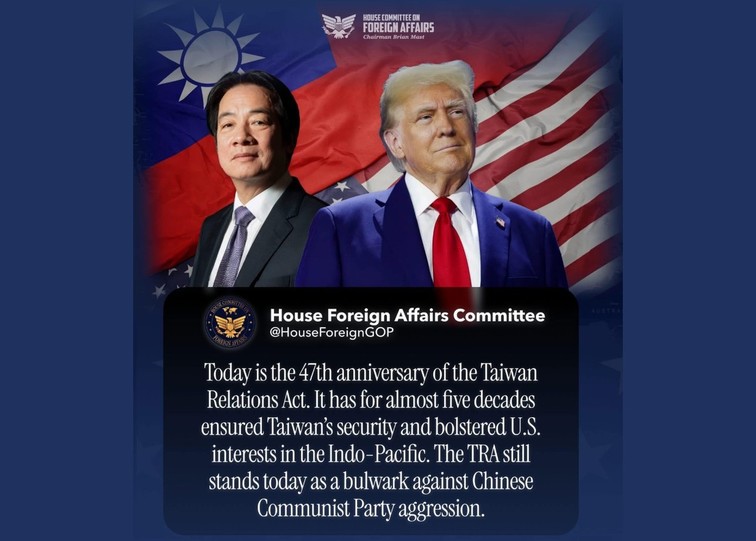
The United States has created a poster featuring Trump alongside Lai Ching-te. Economist Wu Jialong interprets this as an implicit confirmation that the U.S. will intervene in Taiwan, as such action aligns with American interests. (Reproduced from Wu Jialong's Facebook)
[People News] After the 'Zheng-Xi meeting', the CCP announced ten so-called measures aimed at benefiting Taiwan. In response to the obstruction of the Republic of China (ROC) President Lai Ching-te's visit to the allied nation of Eswatini (known as Swaziland in the mainland), the Mainland Affairs Council (MAC) condemned the CCP's blatant interference in President Lai's travel plans, emphasising that this action underscores the Beijing authorities' true stance of 'false goodwill and real threats' towards Taiwan.
Taiwan must recognise the CCP's dual strategy.
According to the Epoch Times, the CCP's pressure on Seychelles, Mauritius (referred to as Mauritius by the mainland), and Madagascar led to the temporary cancellation of flight permits, hindering President Lai Ching-te's visit to Eswatini. The MAC expressed strong condemnation of this interference, asserting that 'the Republic of China is a sovereign nation. For many years, our president has visited Eswatini multiple times, and maintaining diplomatic relations is our legitimate right. The CCP has no authority to interfere and no position to intervene.'
The MAC further noted that 'the CCP recently announced ten so-called policy measures, only to immediately disrupt our president's travel schedule maliciously,' highlighting that the Beijing authorities' approach towards Taiwan is characterised by 'false goodwill and real threats', 'offering benefits with one hand while suppressing with the other.' The public should be aware of the CCP's dual strategy.
The Mainland Affairs Council has issued a warning to the Beijing authorities, asserting that the Republic of China has the right to engage and develop relations with countries worldwide. The Chinese Communist Party's (CCP) aggressive suppression will not alter Taiwan's resolve to connect with the world and participate in the international community. The government will steadfastly defend national sovereignty and urges the international community to collectively condemn the CCP's violent actions, supporting Taiwan's rights to engage and interact with other nations through tangible actions.
Earlier, on the evening of the 21st, Pan Meng'an, Secretary-General of the Presidential Office of the Republic of China, highlighted at a press conference that certain countries unjustly revoked flight permits for chartered flights, with the underlying reason being the CCP's intense pressure, including economic coercion. When asked by the media whether he believed the CCP's goodwill was insincere following the 'Zheng-Xi Meeting', he pointed out that while the Beijing authorities claim to have goodwill towards Taiwan and advocate for peace across the Taiwan Strait, they continue to threaten and suppress Taiwan. This incident further demonstrates that China's (CCP) goodwill is false, and the threats are genuine.
In response to the 10 measures announced by the CCP towards Taiwan after the 'Zheng-Xi Meeting', the Ministry of Economic Affairs of the Republic of China stated that Taiwan's economic performance has been remarkable in recent years. According to the latest forecast from the Asian Development Bank (ADB) on April 10, 2026, Taiwan's GDP growth rate for 2026 is projected to be 7.6%, making it the highest among emerging economies in Asia and exceeding that of Japan, South Korea, and Hong Kong. Taiwan will continue to pursue its own goals in developing five major trusted industries and ten AI infrastructure projects, aligning closely with the global community, and will not revert to dependence on the CCP.
In response to President Lai Ching-te's postponed visit to Eswatini, Chinese Nationalist Party (KMT) Chairman Cheng Li-wen remarked on the 22nd that this represents a significant diplomatic setback that should not be overlooked. The entire world can accept the 1992 Consensus and does not support Taiwan independence; why can the government act unilaterally, resulting in ongoing diplomatic failures? It is sometimes necessary to reflect on oneself rather than criticise others.
A Call for Clear Recognition of the True Nature of the Chinese Communist Party
On the 22nd, the Democratic Progressive Party (DPP) convened a Central Executive Committee meeting, during which President of the Republic of China and DPP Chairman Lai Ching-te announced that he was originally scheduled to lead a delegation to visit the Kingdom of Eswatini, a diplomatic ally, to congratulate King Mswati III on his 58th birthday and to celebrate the 58th anniversary of diplomatic relations between the Republic of China and Eswatini. However, due to pressure from the Chinese Communist Party (CCP) on a third country, the flight permission was unexpectedly revoked, necessitating the cancellation of the visit. He personally called King Mswati III to wish him a happy birthday and apologised for being unable to attend the celebration in person. Both he and King Mswati III expressed regret but reaffirmed that the friendship between the two nations remains intact; under external pressure, they will only grow more united and cooperative.
Lai Ching-te emphasised that Taiwan is a sovereign nation, the Taiwan of the world, and that the 23 million Taiwanese people have the right to engage with the global community, and no country can impede this. The more the CCP suppresses, the more they must exhibit a fearless spirit, continuously enhance national strength, and steadily advance onto the international stage.
Additionally, Lai Ching-te expressed heartfelt gratitude to the democratic partners who have been assisting Taiwan in negotiations in recent days, as well as to the diplomatic personnel working tirelessly on the front lines. Moving forward, Taiwan will continue to collaborate closely with like-minded democratic allies to jointly uphold peace and stability in the Indo-Pacific region and protect the values of freedom and democracy.
In conclusion, he urges domestic political parties, regardless of their affiliations, to clearly identify the true nature of China in light of the Chinese Communist Party's (CCP) actions that undermine regional harmony and violate Taiwan's sovereignty. All parties should unite to protect the dignity of the nation.
Taiwan must implement countermeasures.
Writer Wang Hao expressed on Facebook that President Lai Ching-te's visit to the allied nation of Eswatini was hindered, highlighting that the CCP has effectively 'weaponised' the international civil aviation system. By exerting economic pressure on countries like Seychelles and Madagascar to retract flight permissions, Beijing is not only isolating Taiwan but also challenging global aviation freedom. In response to this widespread authoritarian expansion, Taiwan cannot limit itself to mere verbal condemnation; it must take concrete and impactful counteractions.
Firstly, Taiwan should enhance its integration with the 'democratic supply chain' involving the United States, Japan, and Europe, tightening regulations on the export of advanced chips and critical high-tech products. It should also rigorously investigate speculative practices involving the transhipment of Chinese goods through Taiwan to 'launder' their origin, thereby cutting off channels that allow the development of authoritarian technologies using Taiwan's resources. Secondly, domestically, Taiwan must strengthen its 'defensive democracy' by intensifying efforts to combat infiltrating Chinese spies and the 'fifth column' within its borders. Lastly, Taiwan should proactively increase its international outreach, revealing to the world how the CCP politicises civil aviation zones and threatens international order. Taiwan should collaborate with international allies such as IPAC, inviting various anti-unification and pro-independence forces to convene international conferences opposing the CCP's 'Chinese National Promotion Law.' We must convey a clear message to the international community: Beijing has no authority to dictate the diplomatic paths of sovereign nations, and Taiwan's resolve to engage with the world cannot be deterred by authoritarian coercion. △






News magazine bootstrap themes!
I like this themes, fast loading and look profesional
Thank you Carlos!
You're welcome!
Please support me with give positive rating!
Yes Sure!