
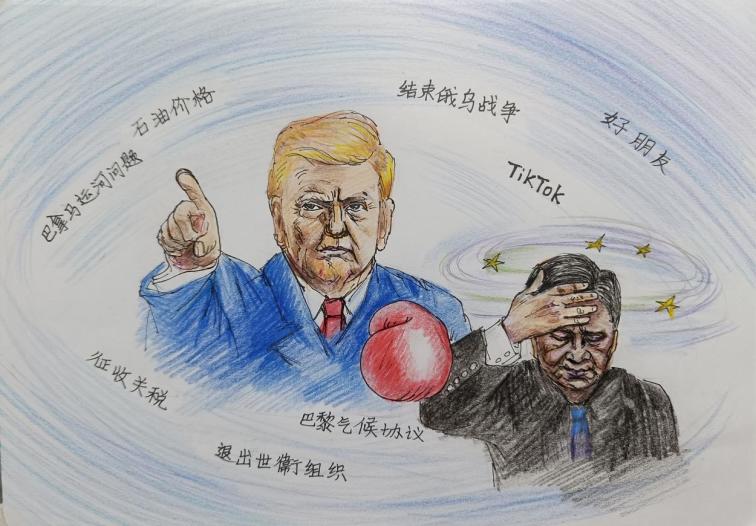
Trump's soft and hard tactics leave the CCP disoriented. (Image by Qing Yu / People News)
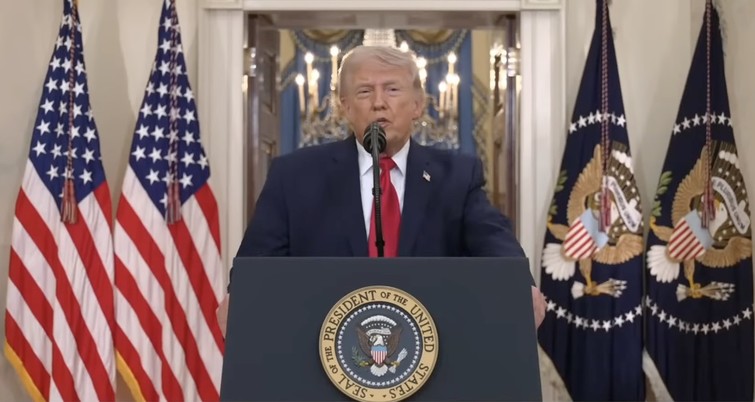
[People News] The US-Iran negotiations have collapsed, and the world is closely watching to see if the guns in the Gulf of Oman will fire again. Trump issued an ultimatum from the White House, stating that the ceasefire agreement has only 3 to 5 days left. According to the New York Post, Trump indicated that the second round of negotiations between the US and Iran could occur within the next three days.
This 72 to 120-hour window serves as the final deadline for Iran. Trump made it clear on Truth Social that these days are not aimed at achieving peace, but rather at compelling the Iranian government to present a 'unified plan.' What does this imply? It suggests to the world that Tehran is currently in turmoil, unable to identify a single decision-maker.
Simultaneously, Trump specifically called out Beijing, stating that China has sent a 'gift' to Iran, but then added, 'Who knows what is inside?' This remark likely left Beijing feeling quite embarrassed. So, what unsavoury items are concealed within this 'big gift package'? Are these 3 to 5 days the last chance for Tehran to survive, or the final test for Beijing?
Beijing's 'big gift package' angers Trump
A couple of days ago, Trump remarked, 'China has sent a gift to Iran, but who knows what is inside?' Just listen to the tone; this is not about gift-giving. It is a clear mockery directed at that liar.
On the 21st, he informed CNBC that the ships intercepted by the US military were carrying 'gifts from China,' and the contents were 'not very friendly.'
Trump also expressed that he was "a bit surprised" because he believed he had reached a "consensus" with Xi Jinping. A week ago, Trump announced that Xi had assured him that China would not supply weapons to Iran. This effectively indicates to the world that Xi Jinping lacks integrity and has deceived him.
On the afternoon of the 22nd, the Chinese Ministry of Foreign Affairs held a routine press conference, during which foreign media asked spokesperson Geng Shuang to respond to Trump's remarks about the "Chinese gift" and to clarify what items were being transported by the cargo ship flying the Iranian flag that had departed from China.
Geng Shuang once again dodged the question, claiming that China had repeatedly expressed its position and asserting that China consistently "exemplarily fulfils" its international obligations.
This time, Beijing has been caught red-handed, and one cannot help but admire how these wolf warriors can lie without a flicker of emotion.
Why did Trump directly name Xi Jinping this time without holding back?
Recently, two interceptions have garnered significant attention, including the Iranian cargo ship "Tosca" being detained while attempting to pass through the Gulf of Oman, and the oil tanker "Tiffany" carrying approximately 1.9 million barrels of crude oil, which was originally intended for China but was intercepted in the Indo-Pacific waters. The Pentagon stated that one of the vessels was a "stateless ship under sanctions."
The U.S. emphasised that the key issue is not only the illegal transportation itself but also the potential supply chain behind it. Former U.N. Ambassador Nikki Haley pointed out that the relevant vessels may be involved in missile supplies; satellite images also indicate that the "Tosca" had docked at Zhuhai Gaolan Port, which is regarded as one of the sensitive trade points between China and Iran.
Simultaneously, the U.S. is actively monitoring military shipments from China and Russia to Iran, which include air defence systems, drones, and missile technology. This indicates that maritime interception is merely a superficial action; the true concern lies in a low-visibility, highly dispersed military-civilian dual-use supply network.
What frustrates Trump the most? It is that Xi Jinping recently assured him in a private message: 'We will never provide military aid.' Beijing was initially engaging in a strategy of 'openly repairing the road while secretly crossing the river': publicly dispatching Wang Yi to make 26 phone calls for so-called mediation, portraying himself as a 'peace ambassador,' while covertly attempting to exploit the ceasefire to swiftly deliver missile fuel to support the hardliners in Tehran.
Consequently, 'human calculations cannot compete with U.S. military calculations.' This list is now sitting on Trump's desk. The reason Vance turned back before boarding the plane, aside from the internal divisions in Tehran, is also linked to this list. Trump told Vance: 'Since Beijing is negotiating peace with me on one hand while plotting against me on the other, there is no need to continue this negotiation with them.'
This substantial package has now become a 'diplomatic deadlock' for Beijing.
The uncertainties surrounding the 'Trump-Xi meeting' in May
At this point, all pressure and attention have shifted back to Beijing. For Zhongnanhai, the most pressing issue is the upcoming 'Trump-Xi meeting' scheduled for May.
Currently, Xi Jinping is confronted with two particularly challenging problems:
Firstly, there is the issue of 'bankruptcy of credibility.' Initially, there was a private assurance to Trump that there would be no military aid, but the 'Tuskar' was bombed, turning the large package inside into a global laughingstock. Trump now possesses this list; he will not engage in business discussions with you in May, but will instead use the list to demand compensation. Beijing has been caught secretly 'stabbing in the back,' which has severely damaged its credibility in international diplomacy.
Secondly, there is the 'loss of control.' Beijing has consistently projected an image of being able to manage Iran, yet the Revolutionary Guard does not take Beijing seriously, directly seizing and bombing ships at sea. This effectively communicates to the world that Beijing's so-called 'great power influence' cannot even reach the doorstep of Tehran during critical moments.
If Beijing can manage to rein in the 'mad dogs' in Tehran in the coming days and get negotiations back on track, there may still be some room for manoeuvre in the May meeting. However, if these days pass and the U.S. military actually opens fire, once the smoke clears in the Gulf of Oman, Beijing will have to confront Trump's most ruthless economic retaliation.
Beijing's current predicament can be summed up in one phrase: 'caught in a dilemma.' Supporting Iran means sacrificing access to the U.S. market; protecting the market means losing face in front of Tehran. The upcoming May meeting between Trump and Xi Jinping is laden with crises for Xi.
The power clash under the U.S. military's ultimatum
Trump's '3 to 5 days' may seem like diplomatic language, but the U.S. military's actions are quite substantial.
Recent satellite imagery and intelligence reports indicate that the U.S. military has sent three AC-130J "Ghost Riders" gunships to a front-line base. This move sends a clear signal within military circles. Unlike standard bombers, this aircraft is specifically designed for "low-altitude precision clearing." Its deployment typically means that the U.S. military has locked onto its targets and is merely waiting for an order to execute specific destruction missions.
Why has Trump decided to deploy these aircraft at this particular moment? The answer is straightforward: he is awaiting a response from Tehran. Over the next three to five days, if Iran remains uncertain about who holds power internally, and if the proposals it presents fail to meet U.S. expectations, then these "ghosts" in the sky will focus on Iran's most vulnerable industrial lifelines, such as power plants and oil terminals.
For Beijing, this period is equally critical.
Trump currently possesses two key cards: one is the military aid list discovered on the "Tuscaloosa," and the other is a drafted executive order imposing 50% punitive tariffs. Trump's reasoning is clear: if you in Beijing cannot control Tehran, and if your so-called "peace mediation" devolves into a mere delaying tactic, then U.S. retaliation will extend beyond military actions.
Beijing's primary concern at the moment is that if the situation spirals out of control, the conflict in the Middle East could directly impact its economic stability. Should negotiations collapse in the coming days and the U.S. military take action, if Trump signs that tariff order, Beijing's foreign trade system would face significant repercussions. This issue extends beyond exports; it also touches on critical aspects of domestic supply chains and employment stability.
With twenty days remaining until the Xi-Trump meeting, who can predict what might unfold in the meantime? Will Xi Jinping be able to wait for Trump in Beijing?
(Originally published by the People News) △




News magazine bootstrap themes!
I like this themes, fast loading and look profesional
Thank you Carlos!
You're welcome!
Please support me with give positive rating!
Yes Sure!