
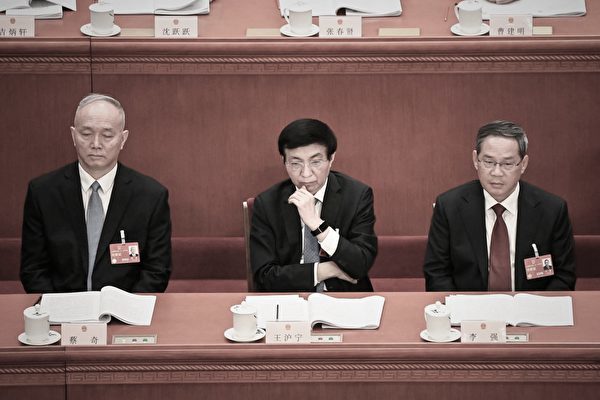
On March 7, 2023, (from left to right) Cai Qi, Wang Huning, and Li Qiang at the Chinese Communist Party&9;s National People&9;s Congress. (Greg Baker/AFP via Getty Images)
[People News] Following the General Secretary of the Communist Party of China's reiteration of the 'correct view of achievements' in January, a brainwashing campaign to 'establish the correct view of achievements' has recently taken hold across China over the past two months. Party and military media throughout the mainland have been producing one themed article after another, all of which are merely superficial works that no one genuinely takes seriously. In this vast dye vat of the Communist Party, nearly all officials have mastered the art of duality; they can proclaim slogans like 'serving the people' and 'urgent for the people's needs,' while in reality, they exploit their power for personal gain. The so-called 'people' are, in their eyes, just different varieties of leeks.
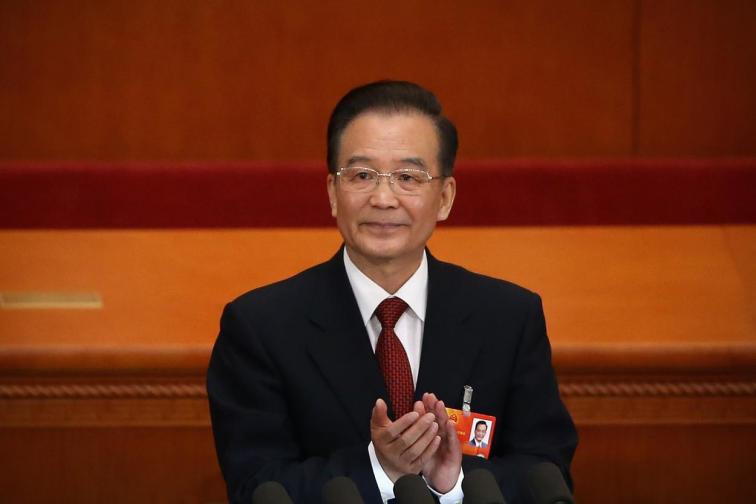
Among these themed news articles, I recently came across a rather humorous report. According to the National Committee of the Chinese People's Political Consultative Conference, on April 17, the Party Group of the CPPCC held a special study class focused on establishing and practising the correct view of achievements, engaging in an in-depth study of Xi Jinping's significant discourse on this topic and facilitating discussions. Wang Huning, a member of the Standing Committee of the Political Bureau of the CPC Central Committee, Chairman of the National Committee of the CPPCC, and Secretary of the Party Group, presided over the meeting and delivered a speech.
After some praise for Xi, with shouts of 'the two establishments' and 'the two safeguards', a statement emerged: 'Everyone unanimously believes that during Xi Jinping's time in local government, he consistently adhered to the correct view of political achievements to accomplish tasks, setting a brilliant example for the entire party.' Therefore, we should learn from Xi's loyal 'firm stance' towards the Communist Party of China, 'the deep commitment to benefiting the people, the clear character of scientific decision-making and seeking truth from facts, and the pragmatic style of being practical and working diligently over the long term...'.
This raises some questions. If Xi Jinping is highly praised for maintaining the correct view of political achievements during his local work, with so much to learn from, then does that mean that after he moved to Beijing, from being a member of the Politburo Standing Committee to the party leader, he no longer upholds this view? Is there suddenly less to learn from?
It is evident that, as high-ranking officials within the Communist Party system, their intention is not to convey what I have suggested. From their viewpoint, they can only assess Xi's achievements during his local tenure, such as his work in Hebei, Fujian, and Zhejiang, while they are neither qualified nor willing to evaluate his performance after he ascended to the central government, even if his achievements there are quite poor.
Nonetheless, whether intentionally or not, the emphasis by senior officials like Wang Huning on Xi's adherence to the correct view of political achievements during his local tenure is rather amusing to those of us who pay attention to such details, and some might even see it as a form of 'high-level black humour.'
First, let’s examine what is meant by 'incorrect performance view.' According to statements from the Chinese Communist Party (CCP) media, this term refers to certain localities that stray from reality, ignore costs, and recklessly incur debt for construction projects. Some officials create grand spectacles and expand their operations, engaging in 'image projects' and 'face projects.' Others resort to falsifying statistics and exaggerating reports, engaging in 'digital performance' and 'false performance.' These issues are all manifestations of a misalignment in performance views, a distortion of power perspectives, and a lack of accountability.'
In February, I wrote an article titled 'The One Who Should Establish a Correct Performance View is Xi Jinping,' in which I noted that many CCP officials at various levels who will undergo this 'performance view' education likely understand that the one who truly needs this education is Xi Jinping himself. Why do I say this?
Let’s consider the achievements that Xi Jinping has touted since he took office in 2012: the 1.8 billion yuan chip project, the Belt and Road Initiative, the Xiong'an New Area, the stock exchange, the Asian Infrastructure Investment Bank, Made in China 2025, the Thousand Talents Plan, real estate, poverty alleviation, energy conservation, 21 free trade zones, the Shanghai free trade zone, and the Hainan free trade zone. Which of these projects was not undertaken without regard for costs, involving massive investments, yet ended up being unfinished? Who dares to publicly criticise Xi for these 'image projects' and 'face projects'?
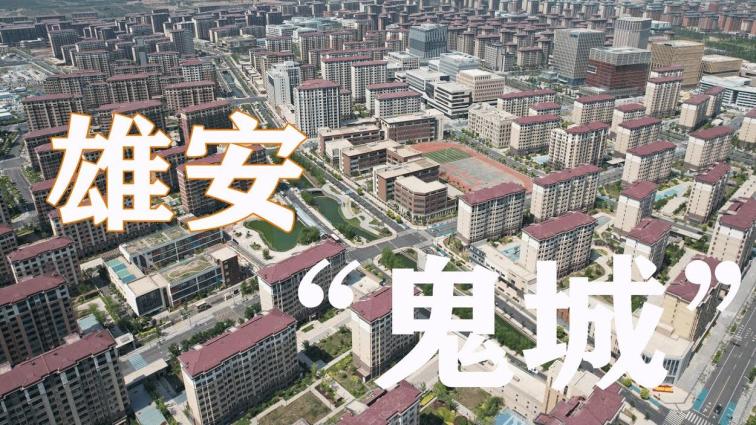
Among these, the most criticised 'image project' and 'face project' are the Xiong'an New Area in Hebei and the Belt and Road Initiative. In 2017, Xi Jinping personally crafted the plan, positioning the geographically disadvantaged Xiong'an as a means to relieve Beijing's functions, with a planned population of 5 million and an investment exceeding 1.5 trillion yuan.
In the past decade, however, the ambitious plan for Xiong'an has devolved into what is now referred to as the 'first ghost city.' By 2025, the vacancy rate in the Rongdong area of Xiong'an is projected to exceed 70%, with the population falling short of the planned one-tenth, leading residents to voice complaints about inadequate infrastructure and a 'boring' lifestyle.
Xi Jinping is understandably reluctant to acknowledge this situation. After consolidating some power by ousting Zhang and Liu, he has ramped up investments in Xiong'an once more. In March, Xi led a delegation of high-ranking officials to Xiong'an, aiming to encourage his subordinates to continue promoting immigration to revitalise the area and uphold his public image. However, given Xiong'an's well-documented geographical disadvantages and cultural environment, how many people from Beijing are actually willing to relocate there? Officials at various levels are now attempting to delay action as much as possible, and if they cannot delay, they are moving at a sluggish pace.
Beyond the ghost city of Xiong'an, the 'Belt and Road Initiative' proposed by Xi in 2013 has attracted over $1 trillion in investments, yet more than 60% of the projects are operating at a loss, sparking international criticism of 'debt diplomacy' and growing discontent among the domestic population. Additionally, the Asian Infrastructure Investment Bank has shifted from being a beacon for nations to a target of ridicule...
If Xi truly possessed a correct perspective on achievements during his local governance, prioritising the welfare of the people, adhering to factual realities, and maintaining a pragmatic approach, then why, upon ascending to the highest office in Beijing, does he appear so focused on grandiosity and neglectful of public welfare? The transition of a party official from understanding what constitutes a correct view of achievements to losing that understanding, as per the Communist Party's assessment, is attributed to a 'distorted view of power and a lack of accountability.' Xi likely fits this description as well.
Reflecting on senior CPPCC officials such as Wang Huning, who are known for their penchant for flattery and their ability to distort the truth, it is noteworthy that this time they only highlighted Xi's local performance for study, while conveniently omitting the numerous criticised achievements from Xi's time as party leader. Could this truly be unintentional? So far, the author has only encountered such a statement once. Wang Huning's sophisticated sarcasm remains quite skilful.
(First published by People News)△




News magazine bootstrap themes!
I like this themes, fast loading and look profesional
Thank you Carlos!
You're welcome!
Please support me with give positive rating!
Yes Sure!