
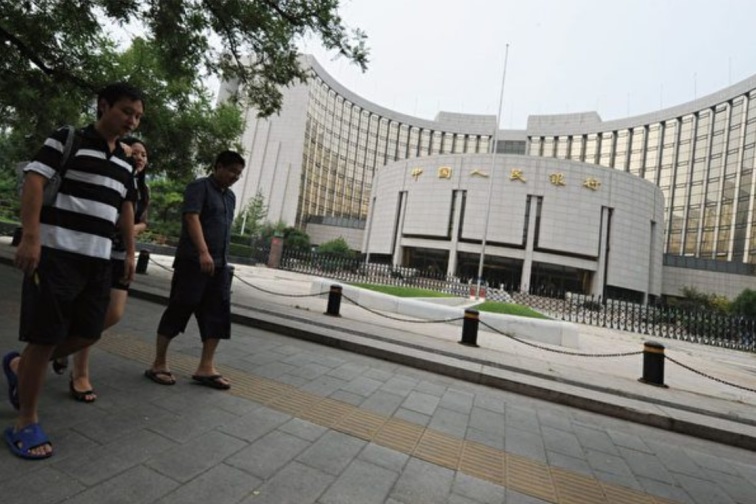
A group of citizens passes by a branch of the People's Bank of China (screenshot from X/@dujuncn)
[People News] In mid-May 2026, the central bank released financial data for April, which showed a rare negative value for new RMB loans, with a significant drop in household loans and a pessimistic outlook for medium- and long-term corporate loans. Almost simultaneously, the Ministry of Civil Affairs and 11 other departments jointly issued the 'Opinions on Promoting the Development of Mutual Assistance Retirement Services,' which strongly advocates for neighbourhood assistance and 'time banks,' aiming for a coverage rate of at least 70% for mutual assistance retirement facilities in urban and rural communities by 2030.
While these two news items may appear unrelated, they actually reflect the current state of the Chinese economy: public confidence is completely absent, and both businesses and residents are hesitant to discuss investment, leading to a continuous contraction in consumption scenarios. Young people are caught between 'saving for retirement' and 'stopping social security contributions,' with long-term social security on the verge of collapse. As the government observes the impending failure of social security, it has initiated a new round of misleading rhetoric, suggesting that future retirement will depend on neighbourhood assistance, with the notion that 'deceiving for a day is better than nothing.'
April financial data: Consumption bottlenecks, with the demand side collectively lying flat.
According to central bank data, by the end of April 2026, the RMB loan balance stood at 280.5 trillion yuan, reflecting a year-on-year increase of 5.6%, with the growth rate continuing to reach new lows. In the first four months, RMB loans increased by 8.59 trillion yuan, but the new loans for April alone were actually -10 billion yuan, marking a year-on-year decrease of 290 billion yuan. The last time there was a negative monthly increase was in July 2025, and prior to that, one would have to look back 20 years to 2005.
The residential sector is exhibiting the most pronounced reluctance to engage. In the first four months of the year, household loans fell by 490.2 billion yuan, with short-term loans decreasing by 610.2 billion yuan, while medium to long-term loans, primarily mortgages, saw only a modest increase of 119.9 billion yuan. In April alone, household loans dropped by 786.9 billion yuan, with medium to long-term loans down by 340.8 billion yuan. Foreign institutions like Goldman Sachs and Yechun have candidly remarked that residents' balance sheets are still in recovery, and both consumption and borrowing willingness have stagnated; businesses are also hesitant to expand production, with medium to long-term loans reaching a historic low, relying solely on bill financing to meet regulatory requirements.
In layman's terms, the general public is currently adopting a strategy of spending less, borrowing less, and saving more. Non-bank deposits have surged, and to safeguard the value of their savings, 'deposit financialization' has emerged as a new trend. Businesses are fully in 'wait-and-see mode,' reluctant to make significant investments. Banks are also exercising caution, lending with great care, akin to squeezing toothpaste. The outcome is negative growth in credit, with social financing being sustained by government bonds and direct corporate financing, revealing a clear structural divide.
This situation reflects the private sector's financial assessment of the economic outlook. The real estate market remains sluggish overall. On the consumption front, major consumer goods such as automobiles experienced a decline in April, and loans for individual businesses have also weakened. Residents' income expectations are unstable, and employment pressures are significant, particularly for young people struggling to secure stable jobs, which naturally leads them to tighten their financial belts. Businesses, facing weak domestic demand and high external uncertainties, prefer to engage in bill arbitrage rather than invest real capital in expansion.
The Paper reports that Li Jing, an investment manager and macro strategy analyst at Yifeng Fund, believes that the unusual negative growth in new loans in April reflects a significant transformation in China's economic financing model. 'Previously, we relied heavily on massive credit and infrastructure booms. Now, as we enter a phase of high-quality development, with the existing loan base expanding and financing methods diversifying, a slowdown in loan growth or even occasional negative growth may become the new normal. The current core task is no longer about 'forcing everyone to borrow money,' but rather about reshaping profit expectations across various industries through technological innovation and industrial upgrades, allowing funds to flow voluntarily into valuable entities.' While industry insiders have pointed out the facts, they have not addressed the underlying issue. The true cause is not a profound transformation of the financing model, but rather a severe derailment. Both businesses and individuals lack hope for the future, are hesitant to invest, and are unwilling to spend, waiting for an even greater economic derailment while holding onto cash to survive the crisis.
Social Security Payment Suspension: 42 Million Young People Vote with Their Feet
If the weakness in credit is simply a reflection of the current economic downturn, then anxiety over pensions and social security represents an unavoidable long-term concern. Recent surveys conducted by the Ministry of Human Resources and Social Security of the Communist Party of China indicate that the number of workers who have suspended their pension insurance payments has surpassed 42 million, accounting for nearly 18% of the total insured population. Among these, the suspension rate for the young demographic aged 25-35 is as high as 31.7%, and nearly 38% for flexible workers. In the first quarter of 2026, the number of young people voluntarily suspending payments rose by 8.6% compared to the previous year.
This data reflects a sober realisation rather than a sudden whim or impulsive decision by the public, resulting from careful calculations and rational considerations. The pension system of the Chinese Communist Party (CCP) operates on a pay-as-you-go basis, where the contributions of young people primarily support the current retired population, particularly those within the institutional retirement framework. With the birth rate continuing to decline, projected to be only about 7.92 million in 2025, the number of new retirees is expected to exceed 8 million, leading to a situation where there are fewer contributors and more beneficiaries. Forecasts from institutions such as the Chinese Academy of Social Sciences indicate that the cumulative balance of the basic pension insurance fund for urban employees may be depleted around 2035, with a current revenue-expenditure gap emerging even sooner. This is due to the fact that within the CCP's social security system, a significant number of individuals who have never contributed a single cent to social security are counted as if they have contributed, creating a substantial gap that the current young generation must cover. The CCP's policy of delaying retirement is merely a temporary fix.
In 2026, many regions across the country increased the social security contribution base, placing an increasing burden on young people and businesses. Surveys show that 78.6% of those who have stopped contributing cite 'current economic pressure' as the primary reason, while 55.7% feel that the contribution burden is heavy. For individuals earning around 4,000 yuan per month, social security contributions can account for 30% of their income—who can sustain that? A post-95 flexible worker in Shanghai faces social security payments exceeding 2,200 yuan each month, with rent at 1,800 yuan, leaving little for food, forcing them to halt contributions to survive in the present. Another individual, a 32-year-old delivery rider named Xiao Zhou, experienced a drop in monthly income from 8,000 to 4,500 yuan, making social security a rigid burden, leading him to stop contributions altogether to save money for living expenses.
The CCP's new deception: neighbourhood mutual assistance for retirement.
Recently, at the end of April, the Ministry of Civil Affairs and 11 other departments released a document that clarifies mutual assistance in elderly care as a voluntary, non-profit initiative within neighbourhoods and communities. This includes promoting the concept of a 'time bank,' where individuals help others with elderly care now and can later exchange points for assistance. Additionally, there are initiatives such as visiting care and mutual assistance 'happiness homes' in rural areas. By 2030, the goal is to ensure that community facilities cover at least 70% of the population.
According to official statements, this initiative aims to supplement the elderly care system and address the diverse needs of an ageing population. Currently, there are 323 million elderly individuals over the age of 60 in China. Traditional family care is diminishing, institutional care is costly, and there is considerable financial pressure, necessitating mutual assistance in elderly care as a safety net. The concept of 'happiness homes' in rural areas and mutual assistance in urban neighbourhoods sounds appealing and supportive.
However, from a practical standpoint, mutual assistance in elderly care may simply be a scheme devised by Chinese Communist Party officials to shift responsibility, lacking any sustainable foundation. This model is presented by the authorities as a 'low-cost' solution to the challenges of an ageing rural population, the decline of family care, and the inadequacy of institutional care, emphasising neighbourhood support, younger elderly caring for older elderly, and the time bank concept. Yet, it faces significant structural challenges in implementation.
Firstly, there is a substantial outflow of young and middle-aged individuals from rural areas, making it difficult for younger elderly to provide care for older elderly. Secondly, the practice of elderly care for the elderly lacks professional expertise, making the actual outcomes unpredictable. Thirdly, the funding chain is fragile, with the Communist Party relying on limited collective investments from villages, minimal government subsidies, and social donations, which essentially amount to empty promises. Fourthly, mutual assistance in elderly care is largely unregulated in terms of institutional design, legal frameworks, industry standards, regulatory measures, infrastructure, and grassroots management. Lastly, the supporting systems for integrating medical care with elderly care in mutual assistance are currently nonexistent.
Following the announcement of the mutual assistance pension proposal, a wave of criticism has erupted online. The Chinese Communist Party (CCP) seems to be shifting its position too rapidly; previously, it was said that raising children would ensure a secure old age, but it shifted to the idea that old age should rely on the government. Later, the government suggested that a portion of wages should be contributed to support the parents of others in their retirement, assuring that the social security bureau would take care of individuals in their old age. Now that the payments have been made, the CCP has altered its narrative once again, stating that one must depend on mutual assistance from neighbours to navigate one's old age. Ultimately, it appears that individuals must still take responsibility for themselves: the elderly support the elderly, friends support friends, and chess companions support one another. This entire concept has been dubbed a 'time bank,' which resembles a permanent Ponzi scheme, cleverly disguised with appealing terminology.
The CCP's economy is faltering, with credit data experiencing a significant drop and the social security fund running dry. Young people are feeling insecure, and even the elderly are facing instability. The grand vision of mutual assistance that has been proposed hasn’t even begun to materialise, yet it is already falling apart.
(First published by the People News)△








News magazine bootstrap themes!
I like this themes, fast loading and look profesional
Thank you Carlos!
You're welcome!
Please support me with give positive rating!
Yes Sure!