
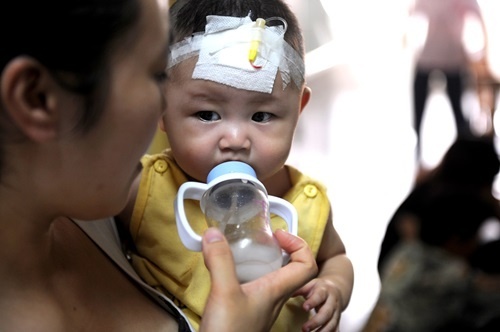
In September 2008, following the melamine-tainted milk powder scandal, a woman is seen holding a sick infant at Chengdu Children's Hospital. (China Photos/Getty Images)
[People News] Food safety issues are rare accidents in other countries, but in China, they have become commonplace, stemming from the Chinese Communist authorities' neglect and tolerance of such criminal activities. It is no surprise that many Chinese netizens humorously remark, 'We are immune to all poisons,' and 'This is a method of population reduction.'
Discovery of 'New Anticide'
Recently, a food safety incident has ignited intense discussions among netizens.
As reported by Hainan netizen '@Yu Sijia Handmade Tea' in a video shared on social media, on May 17, while walking in her community with her child, the child accidentally dropped some jerky crumbs on the ground, which attracted a swarm of ants. When the netizen attempted to clean up, she was shocked to find that all the ants had died within just 2 to 3 minutes.
The netizen also flipped over the jerky's packaging to investigate and discovered that the ingredient list included ethyl maltol (a flavour enhancer) and sodium nitrite (a preservative). The manufacturer of this jerky is 'Sichuan Meishan Tiantian Fishery Food Co., Ltd.'
Public records indicate that Sichuan Meishan Tiantian Fishery Food Co., Ltd. is a joint-stock company engaged in the deep processing and sales of freshwater fish, recognised as a key leading enterprise in agricultural industrialisation in Sichuan Province.
In this context, an analysis by Elephant News suggests that ethyl maltol, which emits a sweet fragrance, can attract ants, while sodium nitrite causes suffocation and death in ants by inhibiting their ability to carry oxygen. The combined effect of these two substances is akin to the mechanism of commercial insect baits. The safety standards for food additives are established based on human metabolism, and the reason ants succumb is due to their small size (approximately 5 milligrams) and rapid metabolic rate. Therefore, the dosage of additives deemed safe for humans could be lethal for ants.
Additionally, a report from Yangcheng Evening News states that sodium nitrite is a preservative frequently used in meat products. It helps inhibit the growth of botulinum bacteria, extends shelf life, and maintains the bright red colour of meat. Generally, it poses no safety concerns; however, under certain conditions, it can transform into the carcinogenic nitrosamine. Excessive consumption can lead to poisoning and may even be fatal.
We are living in an age of mutual poisoning.
Netizens have commented, "If ants die after consuming crumbs containing sodium nitrite, can this snack still be safe for children?" "With the recent alarming news about toxic bayberries, it seems ants that consume them for three generations also perish. Marked 8000!" "We are already in an era of mutual poisoning." "Now, we don’t need foreign invasions; we can self-destruct. I wonder what else can be eaten with confidence. Moreover, there’s no oversight; newborns are diagnosed with terminal illnesses, and there’s only one day a year, March 15!
Some netizens humorously remarked, "I’ve found a new ant-killing solution!" "I have a lot of ants at home; which brand should I buy to eliminate them?" One netizen responded, "Basically, all the snacks available on the market can do that."
Some netizens commented, 'Last night I had hot pot, and the boxed beef and lamb I bought, even my dog wouldn't eat it. It must be loaded with additives.' 'I knew they were doing this 30 years ago. Even cockroaches avoid these things; they fully showcase the ugliest and most evil aspects of human nature!' 'This is the confidence of a technologically advanced nation, leading by a wide margin!' 'All fruits and vegetables are excessively treated with pesticides...' 'Chinese intellectuals are the most unscrupulous users of technology!' 'This is a diminishment of the people.'
The Materialism of 'Survival of the Fittest'
In China, the mentality of 'I don't eat what I grow myself, but sell it to others' reflects a mutual harm mindset, which is a result of decades of brainwashing by the Chinese Communist Party through 'atheism.' When people lose faith in gods or Buddhas, and in the concepts of good and evil retribution, traditional moral principles such as 'Do not impose on others what you do not desire' or 'There are deities three feet above your head' have been eroded over prolonged political movements. In their place, materialism focused on 'survival of the fittest,' which emphasises the primacy of survival, has emerged. The saying 'If one does not act for oneself, heaven will punish them' has become a common motto, and 'lack of integrity' and 'mutual moral harm' have become prevalent social issues.
As a result, a vicious cycle is gradually taking shape in China: farmers do not consume the vegetables they grow, instead selling them to workers; workers, in turn, do not eat the substandard food they produce, but sell it back to farmers. Technicians, who eat the food produced by both farmers and workers, continue to develop more chemical products, which makes food production faster and cheaper. Ultimately, everyone finds themselves in hospitals seeking treatment. To their surprise, the hospitals and pharmacies are selling counterfeit medicines... Thus, in China, no one is truly safe. The only exception is those who consume or use the 'special supply products' reserved for high-ranking officials of the Communist Party.
Review of Major Food Safety Incidents
Over the past few decades, China has witnessed several severe food safety incidents that have shocked the public due to their extensive reach, profound impact, or alarming methods. Below are some of the most notable food safety scandals that have garnered significant social attention:
1. The 2008 Melamine Milk Powder Incident
This incident is widely regarded as one of the most impactful and shocking events in China's food safety history.
Multiple dairy companies, led by the Sanlu Group, added the industrial chemical 'melamine' to milk powder to artificially inflate protein content during quality testing. This resulted in hundreds of thousands of infants developing kidney stones, with several fatalities. The incident severely undermined the reputation of domestically produced dairy products in China and led to a collapse of consumer trust in the entire milk powder industry.
2. The Gutter Oil Incident
This ongoing and highly controversial food safety issue involves many illegal operators who filter, refine, and decolourise recycled kitchen waste oil, commonly known as gutter oil, and then resell it as 'edible oil' to restaurants, canteens, or street vendors. Gutter oil contains carcinogenic substances, such as aflatoxins, and long-term consumption can pose serious health risks. This issue has sparked significant panic online and has become synonymous with 'tainted food' in China.
3. Lean Meat Powder Pork Incident
To increase the lean meat content of pork and reduce fat, some farmers have illegally added 'lean meat powder' (including stimulants like clenbuterol hydrochloride) to animal feed. Consuming meat that contains this substance can lead to acute poisoning symptoms, including palpitations, muscle tremors, and dizziness. The 'Shuanghui Lean Meat Powder Incident' in 2011 caused widespread panic and shock, leading to a national crisis of trust in pork products.
4. 2024 Tanker Mixing Incident
This recent major incident has once again severely undermined public confidence. Reports have emerged that in China, tankers used for transporting chemical products like kerosene were not cleaned before being loaded with edible oils (such as soybean oil) for transport. This practice raises significant food safety concerns due to the potential for chemical residue contamination. In the aftermath of this incident, public opinion has cast serious doubts on the logistics management and food safety oversight processes.
5. Other Noteworthy Incidents
Beyond the incidents mentioned earlier, history has seen numerous other food scandals that highlight various problems within the production chain, including Sudan red duck eggs, dyed steamed buns, industrial salt posing as edible salt, and soy sauce made from hair, among others.
Social Reflection and Regime Change
These events have made Chinese consumers acutely aware of food quality, leading to the emergence of the term "technology and ruthless practices," which has gained popularity online in recent years.
Although the Chinese Communist Party (CCP) has taken steps to strengthen relevant laws, such as the Food Safety Law, following these incidents, their actions often amount to "loud thunder but little rain." The so-called strict enforcement of laws tends to remain a matter of public relations. Additionally, unscrupulous merchants who produce toxic food frequently have bureaucratic forces acting as their protectors. Under the CCP's authoritarian regime, which regards the lives of citizens as trivial, officials tend to shield one another. Consequently, many cases end with only a few minor officials or scapegoats being apprehended, and then the issues are quietly dropped.
Moreover, whenever a food safety incident arises, the authorities' swiftest response is to impose media censorship, silencing the press, deleting comments from netizens, and arresting those who reveal the truth, all under the guise of "maintaining social stability."
Furthermore, within the CCP's system of mutual protection among officials, collective lawsuits by food safety victims and the pursuit of fair compensation are incredibly challenging, with a very low success rate. Many victims also find themselves targeted by the authorities for suppression.
Some netizens have pointed out that the frequent food safety issues and the CCP's attitude represent "a way to diminish the people."
As a result, the public has slowly come to realise that food safety is not merely a chemical issue (referring to ingredient lists) or a moral issue, but fundamentally a political one. To effectively tackle food safety concerns, it is essential to hold accountable those who supervise, those who benefit, and those who enforce the laws, all of which ultimately lead back to the Chinese Communist Party. There is a growing consensus that only a change in regime can fundamentally resolve food safety issues.
(First published by People News)△






News magazine bootstrap themes!
I like this themes, fast loading and look profesional
Thank you Carlos!
You're welcome!
Please support me with give positive rating!
Yes Sure!