
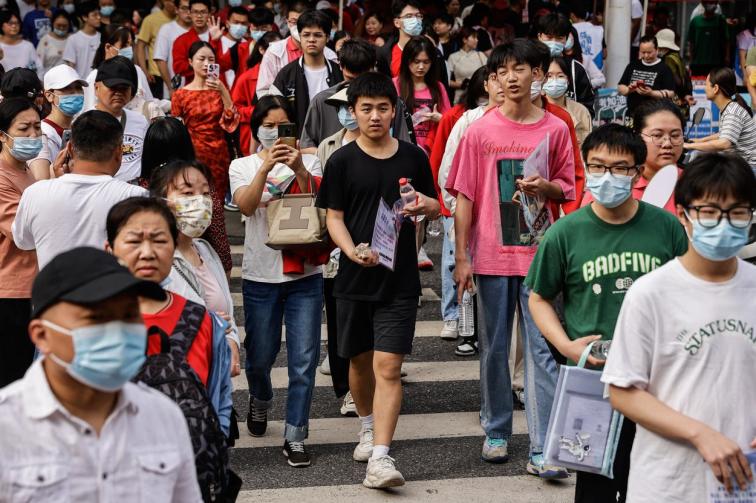
Chinese students participating in the Gaokao exam. (Photo by Getty Images)
[People News] In recent years, there has been a notable trend of decreasing enrollment numbers for China's college entrance examination. According to data from the Ministry of Education of the Communist Party of China, the number of candidates for the national college entrance examination in 2025 is projected to be 13.35 million, a decrease of 70,000 from the historical peak of 13.42 million in 2024. This marks the first decline in eight years.
As we move into 2026, this downward trend continues, with the number of candidates further falling to 12.90 million, a significant drop of 450,000 from the previous year. This shift in data breaks the pattern of continuous growth that has persisted since 2018, when the number rose from 9.75 million to a peak of 13.42 million, before beginning to decline.
On the surface, this decline is linked to adjustments in the statistical criteria for the college entrance examination, the diversion of vocational school students into the workforce, and fluctuations in the eligible population. However, the deeper underlying cause is the harsh economic realities on the mainland that have led to the devaluation of degrees, along with the resulting shifts in family education choices, expectations, and the reshaping of social values. This unusual phenomenon within the education sector reflects subtle signals that the entire economy of the Communist Party is facing risks and challenges, and that the social structure is beginning to experience instability, which warrants external attention.
The Communist Party's college entrance examination has long been viewed as a ladder for students to change their destinies, with attending university symbolising a leap in social class and embodying the hopes of countless ordinary families. From the restoration of the college entrance examination to the popularisation of higher education, China has successfully transitioned from elite education to universal education in just a few decades, exceeding expectations and capacity.
As higher education institutions expand their enrollment, the number of undergraduate colleges has skyrocketed, and the scale of graduate enrollment has reached astonishing levels, with the number of university graduates increasing from millions to tens of millions each year. However, during economic downturns, when employment demand significantly contracts, the ongoing expansion of enrollment leads to an oversupply of talent, which quickly diminishes the value of a university degree. The consecutive declines in 2025 and 2026 directly reflect this devaluation process at the application stage. Increasingly, families are reassessing the return on investment in their children's education: can four years of university or even longer graduate studies still provide stable returns? With job security uncertain, the diploma acquired through substantial family investment becomes merely a certificate of debt consumption.
The Harsh Reality Behind the Data Turning Point
Reviewing historical data from 2018 to 2024, the number of college entrance examination applicants exhibited a steady growth trend, rising from 9.75 million, 10.31 million, 10.71 million, 10.78 million, 11.93 million, 12.91 million, to a peak of 13.42 million in 2024. This growth is partly attributed to the continuation of the demographic dividend and the widespread access to education, but also includes factors such as the inclusion of vocational education statistics in college entrance examination data. The figures of 13.35 million in 2025 and 12.90 million in 2026 signify the onset of a turning point in the decline of college entrance examination applicants.
Although the population born in 2008, which corresponds to the 2026 college entrance examination, is approximately 10.68 million—showing a slight increase compared to previous years—the actual number of applicants has declined contrary to expectations. This suggests that the factors directly contributing to the decrease in college entrance examination registrations are not related to demographic changes. Official analyses cite three common reasons: changes in statistical criteria, an increased willingness among vocational school graduates to seek employment, and the widespread availability of higher education prompting some students to explore alternative paths. However, these explanations do not address the fundamental issue—the devaluation of academic credentials is diminishing the allure of the college entrance examination.
The devaluation of academic credentials is undermining the college entrance dreams of many families.
The devaluation of academic credentials stems from the expansion of higher education and the imbalance in the economic structure. The surge in university enrollment at the end of the 1990s led to an oversupply of graduates. Each year, over 12 million university graduates enter the job market, with projections of 12.22 million by 2025 and a record high of 12.7 million this year, while the youth unemployment rate has consistently remained elevated at 15%-20%.
At present, the Chinese economy is undergoing significant challenges, marked by a downturn in the real estate sector, the relocation of manufacturing, weak consumer demand, and a drastic contraction in the job market. A wave of corporate bankruptcies has surfaced, particularly affecting the real estate and education training industries, resulting in the loss of tens of millions of jobs across various sectors. In 2025, millions of export-oriented companies are expected to suffer severe impacts due to U.S. tariff policies, leading to increased vacancy rates in factories located in Dongguan, Shenzhen, and the Yangtze River Delta. Labour-intensive sectors such as footwear, plastics, and furniture are facing substantial losses, with orders nearly reaching zero, and 70% of businesses reporting losses, alongside frequent incidents of production halts and business owners absconding. In 2024, nearly 3 million restaurants in the catering industry are projected to close, with continued pressure into 2025. By 2026, the express delivery and takeout sectors will experience intense internal competition, resulting in an oversupply of 16 million delivery riders. Numerous supermarkets in major cities like Shanghai and Beijing are expected to shut down, leading to bleak conditions in the retail industry. Furthermore, private hospitals, kindergartens, and public transport systems are facing large-scale closures and suspensions due to demographic decline and fiscal shortfalls.
In this environment, educational qualifications have lost their status as a ticket to the job market. Previously, a bachelor's degree was the minimum requirement for entering the middle class; however, today, even graduates from prestigious 211 and 985 universities find it challenging to secure employment. The percentage of graduates from top institutions such as Peking University and Tsinghua University pursuing further studies has increased from approximately 50% to 66%. It is now common for graduates from less prestigious universities to transition into sales, delivery, or flexible jobs, and instances of doctoral candidates applying for auxiliary police roles and master's graduates taking up cleaning jobs are becoming increasingly common. Data from platforms like Zhaopin indicates that the job-seeking success rate for individuals with master's degrees or higher has fallen to around 44.4%, with some graduates from non-double first-class universities experiencing even lower employment rates.
The dual pressures are directly reflected in the examination registration process. Some families are opting to have their children enter vocational education early or go straight into the workforce; pursuing a regular undergraduate degree is no longer seen as the golden opportunity to change one's destiny, but rather as an investment black hole for average families.
The economic burden on households has become unbearable.
The decline in the number of applicants for the college entrance examination is partly due to the heavy financial strain on families. In recent years, many universities have significantly raised their tuition fees, with increases ranging from 10% to 54%. In some provinces, certain majors have entered what is referred to as the 'ten-thousand yuan era.' This situation arises from local governments facing financial difficulties, including shrinking land revenues and high debt pressures. The growth rate of funding for education has slowed or even declined, while the costs associated with running universities—such as faculty salaries, infrastructure projects, equipment purchases, teaching and research expenses, and property management—are all on the rise. With insufficient financial support, universities have no choice but to increase tuition and accommodation fees. For ordinary families, the total cost of four years of university can easily exceed 100,000 to 200,000 yuan, which is equivalent to several years of savings for low- to middle-income households, making it unaffordable for children from rural backgrounds.
Faced with economic pressures, some families are choosing to have their children enter the workforce early or pursue vocational education, thereby avoiding the risks associated with educational debt and the uncertainties of investment returns.
The solidification of social classes and the focus on power are discouraging parents.
The phenomenon of class solidification within the Chinese Communist Party (CCP) has severely affected educational development and the differentiation of social structures. Education has become a tool that the CCP seemingly offers to lower classes, which appears to provide a pathway into upper-class society. On the surface, education as a means of upward mobility seems to possess a degree of openness and fairness.
In reality, for an ordinary family, if a child truly wishes to change their destiny through the college entrance examination and rise to the upper class, it requires relentless effort from the entire family across several generations. This involves significant investments of money, energy, and time. From the very beginning in kindergarten, families must invest in various tutoring and coaching classes, as well as give red envelopes and gifts to teachers to foster relationships. After middle school, they need to purchase expensive homes in desirable school districts. When it comes to college, the financial burden on the family increases even further. However, the most critical issue is that both you and your child must align with the Communist Party's educational system, which imposes communist values, and actively accept the political indoctrination from schools while undergoing political scrutiny. As a result, most children who receive education in mainland schools lack independent thinking skills, their behaviours diverge from universal values, and they often become 'little pinks' and accomplices of the Communist Party.
Despite this, in a society driven by power, the educational resources available to children from ordinary families are vastly inferior to those enjoyed by the Communist Party's elite, families within the system, and wealthy children. Regardless of how hard they work or how well they perform in school, the employment opportunities and future prospects after graduation cannot compare to those of the true descendants of the Zhao family. This is especially true during the current economic downturn, where it has become increasingly difficult for ordinary children to secure positions in public institutions, become civil servants, or join monopolistic high-quality state-owned enterprises. Elite families can resolve issues with a simple phone call or a meal, as everything in Communist society revolves around power, resulting in a situation where connections are valued more than academic achievements. During economic downturns, desirable job positions tend to favour already privileged groups, leading to heightened feelings of frustration among ordinary people.
The decline in confidence and hope among lower-income families has led to a natural decrease in their willingness to invest in education. Consequently, the employment rate for university graduates from rural and ordinary family backgrounds is significantly lower than that of their urban counterparts. The idea that education is ineffective is making a comeback. This issue extends beyond education itself; it reflects the broader social stratification and severely distorted distribution mechanisms under the Chinese Communist Party (CCP).
The drop in the number of applicants for the college entrance examination is a result of multiple overlapping structural shocks, rather than just a simple population decline. At a deeper level, factors such as economic stagnation, rising education costs, and the depletion of educational resource mobility are dampening enthusiasm for educational investment. When ordinary people perceive that 'effort is in vain,' the Gaokao system is likely to encounter a trend of disengagement.
(First published in the People News) △






News magazine bootstrap themes!
I like this themes, fast loading and look profesional
Thank you Carlos!
You're welcome!
Please support me with give positive rating!
Yes Sure!