

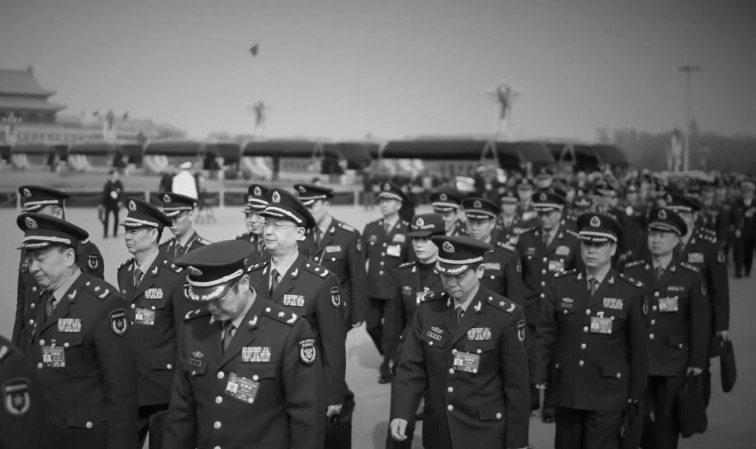
March 11, 2025 — Exterior of the Great Hall of the People in Beijing. On this day, the CCP’s National People's Congress concluded. (Pedro Pardo/AFP via Getty Images)
[People News] With the anniversary of the June Fourth Incident approaching, discussions about the nation's future have intensified. I am not particularly optimistic about China after the fall of the Communist Party, as the slave-like education imposed by the Communist Party has led most Chinese people to lose their basic cognitive abilities, resulting in a severe polarisation of thoughts and interests. Once the Communist regime collapses, establishing a democratic and free national system will not be an easy task in the short term.
For the Chinese people to save themselves, they must first sever ties with the Communist Party. To do this, they need to recognise the true nature of the Communist Party. Understanding this essence requires acknowledging that the Chinese people's century-long allegiance to the Communist Party has been a grave historical misjudgment: believing in communism from the outset was a mistake, assisting the Communist Party in seizing power was a mistake, following the Communist Party to implement socialism was a mistake, opposing America alongside the Communist Party was a mistake, and supporting the Communist Party's ambitions to annex Taiwan was also a mistake.
The Communist Party seized power with the support of the working class and farmers, appropriating national resources and wealth for its own benefit. Officials at all levels of the Communist Party exploit their power to protect their families, enjoying wealth and prosperity while leaving the working class and farmers at the bottom of society. The Chinese people fought and sacrificed for the Communist Party, ultimately creating a class of elites who ride on their backs. Given that the revolution has not liberated the people, why should the Chinese people continue to follow the Communist Party?
Historical experience indicates that the success of the Chinese Communist Party (CCP) revolution and the establishment of a public ownership economy fundamentally involve the appropriation of national resources, the monopolisation of state power, and the exclusive enjoyment of national wealth, with the Chinese people merely serving as tools manipulated by the CCP. Each time the CCP pursues socialism, it results in economic collapse, prompting the party to turn to the market economy for salvation, which invariably leads to economic recovery. Initiatives such as 'Three Selfs and One Package' after the three-year Great Famine and the economic reforms following the Cultural Revolution have all contributed to reviving China. Essentially, socialism has harmed China, while capitalism has been its saviour.
Given that socialism has harmed China and capitalism has rescued it, why does the CCP not prioritise the fundamental interests of the Chinese people, reform itself, change its approach, and adopt a capitalist free system? The reason is that once it embraces capitalism and pursues universal values, the CCP would lose its monopoly on political power and social wealth, thus forfeiting its indulgent and hedonistic lifestyle.
The facts demonstrate that the CCP's commitment to its revolutionary path and the dictatorship of the proletariat is not rooted in the common interests of the Chinese people, but rather in the private interests of a single party. Consequently, its revolution has no connection to the Chinese populace.
After seizing power, the CCP viewed the United States as its primary enemy. Historically, the U.S. has been the country that has provided the most assistance to China. Whenever the CCP faces challenges, it first considers the United States. Mao Zedong sought to establish peace with the U.S. to counter the Soviet Union and initiated diplomatic relations; Deng Xiaoping, in a bid to save the CCP, did not hesitate to lower his stance to seek American aid. The U.S. has helped China without expecting anything in return, while the CCP has repaid kindness with hostility.
The United States has provided technology and investment to China, nurtured Chinese students studying abroad, and supported China's entry into the United Nations. As a result, the Chinese people have gained countless benefits from the United States, which suggests that there is fundamentally no reason for them to harbour animosity towards it. During the Korean War, the Chinese Communist Party (CCP) army engaged in combat with the United States, but it was not the United States that attacked China; instead, it was the CCP that intervened in Korea. The CCP assisted Kim Il-sung's government in fighting a pointless war, leading to significant Chinese casualties. The United States, as the CCP's adversary, was a foe that the CCP brought upon itself, and this has nothing to do with the Chinese populace.
Why does the CCP relentlessly oppose the United States? Because it seeks to compete with the U.S. for global supremacy. The CCP's ultimate ambition is to liberate all of humanity and achieve global dominance, which can only be accomplished by overpowering the United States. Thus, anti-American sentiment is ingrained in the political DNA of the CCP; no matter how the world evolves, its opposition to the U.S. will remain unchanged. However, what does the CCP's animosity towards America have to do with the Chinese people? The Chinese do not need to dominate the world or eradicate capitalism; they simply need to integrate into the global community to enjoy a better life.
The CCP's rivalry with the United States is rooted in ideology, while the Chinese people and Americans do not fundamentally oppose each other ideologically. Both nations' citizens desire world peace, national progress, and the happiness of their people, and they do not wish to see the world engulfed in conflict. If the Chinese people open their eyes to the world, they will recognise that the American system is superior to China's. They will understand that if the CCP were to replace the United States as the world's hegemon, it would lead to a catastrophic disaster for the entire globe. Therefore, for the Chinese people to align with the CCP in opposing the United States is to act against their own interests.
The Chinese Communist Party (CCP) has been in power for over seventy years, consistently fixated on the goal of liberating Taiwan, even going so far as to prepare for a potential massacre. The hardships faced by the Chinese people have never originated from Taiwan; when have the Taiwanese ever taken wealth from the Chinese? When have they ever harmed the Chinese in any way? In the early days of China's reform and opening up, Taiwanese investors established factories on the mainland, aiding in the expansion of international markets and playing a crucial role in improving the impoverished lives of the Chinese people. There is no justification for the Chinese to turn against the Taiwanese and destroy Taiwan in the name of the CCP's unification agenda.
If war breaks out in the name of 'unifying the motherland,' both sides of the strait will be engulfed in conflict, leading to loss of life and destruction of homes, obliterating the stable living conditions that currently exist. In such a scenario, while the CCP may achieve its goal of unification, the prosperity of Taiwan today would be irretrievably lost, and the people of the mainland would also descend into a hellish existence due to the war.
Is the unification of the motherland truly that significant? Throughout China's three thousand years of history, periods of division have outlasted those of unification, and division is not necessarily a negative outcome. Instead of having people suffer together in poverty and losing their political rights due to unification, it is preferable for them to enjoy a happy and fulfilling life in a state of division. Today, Taiwan boasts a robust democratic system, a flourishing economy, and its people enjoy freedom and happiness. Yet, due to the CCP's ambitions for unification, the Taiwanese are threatened with the horrors of war; one must question what benefits this brings to the Chinese people.
Taiwan's democratic system stands as a striking example for the Chinese people. The Chinese Communist Party (CCP) understands that an authoritarian regime cannot withstand comparison and fears that the Chinese populace may start to question its autocratic rule. Consequently, the CCP is eager to eliminate Taiwan's democracy. The so-called national unification promoted by the CCP harbours a dark ulterior motive. Those Chinese who support the CCP's armed aggression against Taiwan not only bring destruction to Taiwan but also, in a broader sense, extend their own suffering.
The Chinese people must first clarify their goals and what they are resisting. They need to examine these issues based on their fundamental interests and avoid falling into the traps of the CCP's rhetorical tricks. It is essential for the Chinese to question everything around them: the actions and words of officials, the experiences of the populace. They should ask: What constitutes public opinion? What defines power? What is justice? What are private interests? Each of these concepts has its origins, implications, and consequences.
The hardest thing in the world is not to take action, but to understand why some actions are taken while others are not. If the Chinese people wish to save themselves, they must first engage in self-reflection. They should not go to Tiananmen Square to witness the flag-raising ceremony, moved to tears; they should not make pilgrimages to Shaoshan and Yan'an, bowing down in reverence; they should not take notes at meetings, filled with righteous anger when discussing the United States and Taiwan independence; they should not see themselves as part of the CCP family, sharing in its fortunes and misfortunes.
It is crucial to recognise that none of the justifications the CCP uses to govern today is aligned with the genuine interests of the Chinese people. The CCP is solely focused on its own power and wealth. As the ancient saying goes: I originally intended my heart to face the bright moon, but alas, the bright moon shines on the ditch!
Source: (author's Facebook) △






News magazine bootstrap themes!
I like this themes, fast loading and look profesional
Thank you Carlos!
You're welcome!
Please support me with give positive rating!
Yes Sure!