
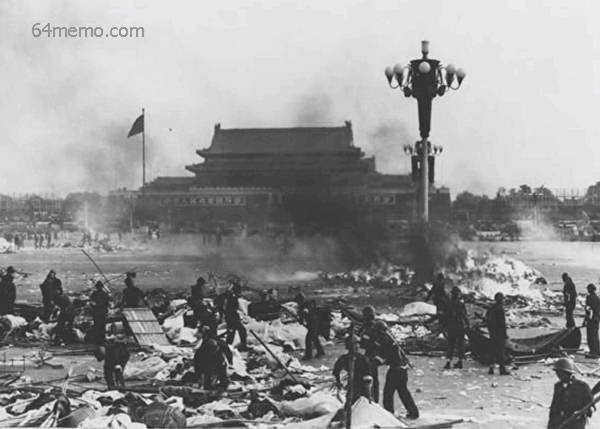
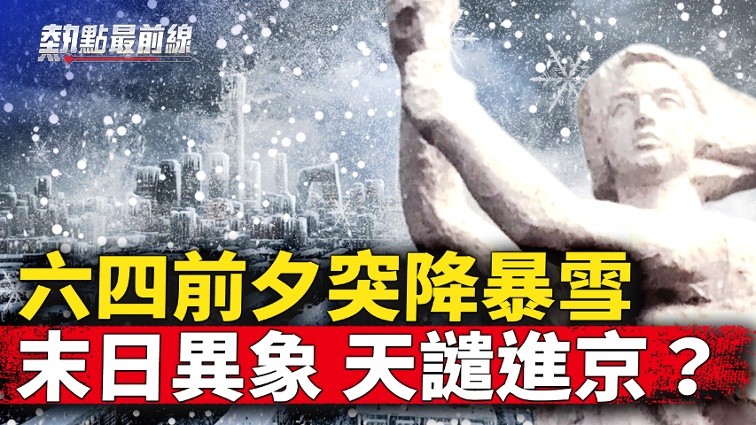
Many out-of-town students living in tents on Tiananmen Square died inside them. (Photo: DaJiYuan ImageLib / Dajiyuan)
[People News] On June 3 and 4, 1989, the Communist Party of China committed the shocking Beijing and Tiananmen Massacre, employing submachine guns and tanks to violently suppress peaceful student and citizen protests.
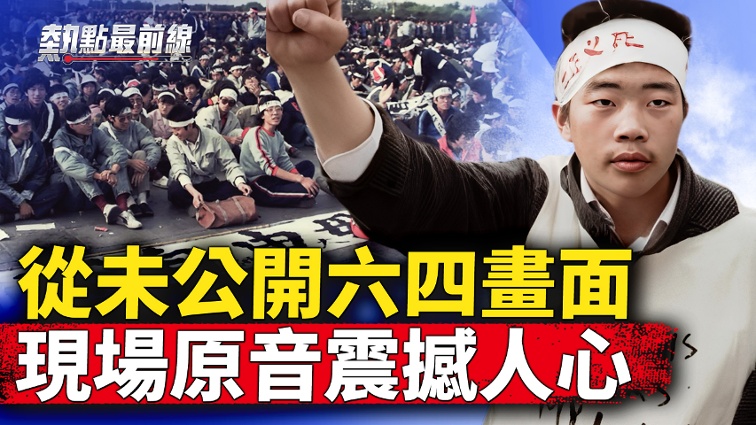
In May 1989, numerous university students from Beijing gathered at Tiananmen Square to initiate a hunger strike against the corruption of Communist Party officials and to advocate for greater human rights. Hundreds of thousands of students and citizens from various sectors of Beijing spontaneously converged on Tiananmen Square to support the hunger-striking students, with the number reaching a peak of 3 million.
At that time, I was a third-year university student and joined my school's faculty and students in supporting the hunger-striking students at the square. Each day, hundreds of thousands of citizens from different walks of life in Beijing flocked to Tiananmen Square to show their support for the students and marched around the square. Additionally, hundreds of thousands of university students gathered in the centre of the square, creating a massive crowd. In the vicinity of Tiananmen, all traffic police, public security officers, and armed police were withdrawn from their posts; there were no police officers visible at the traffic booths or in Tiananmen Square, and order was entirely maintained by the students themselves. Remarkably, there was no disorder whatsoever, and everything was orderly. I visited the square daily and never witnessed or heard of any fights or thefts. This demonstrates that without the Communist Party, the people can manage society more effectively.
A wide array of food and beverages sent by various sectors of the capital to support the students piled up like a mountain, offering everything imaginable. Everyone was genuinely taking on responsibilities voluntarily. A few university students and I happened to be standing next to a pile of food and drinks, so we naturally took on the task of distributing the food. Those of us in charge of distribution did not take advantage of our position to enjoy the benefits first; instead, we prioritised distributing to others. The individuals receiving the food only took what they needed, and no one took more than their fair share. The patriotic movement of the students in Tiananmen Square inspired the public, who set aside their personal interests to focus on the future of the country and the nation.
At that time, the Chinese people had long suffered persecution from the evil Chinese Communist Party (CCP), and many hoped to seize this opportunity to force the CCP to step down. Some also recognised that democracy is not without its flaws. For these individuals, the specific political system that China would adopt in the future was not the most critical issue; the urgent priority in 1989 was to eliminate the CCP.
Despite the orderly situation in Beijing, where tens of millions of ordinary citizens were living and working peacefully, the ruling Communist Party was on the brink of losing its power and interests. Consequently, on May 20, martial law was declared, and hundreds of thousands of troops were dispatched into the city to prepare for the suppression of the students. However, these incoming troops were met with resistance from hundreds of thousands of unarmed Beijing citizens who spontaneously blocked their paths. From that day forward, Beijing effectively liberated itself from the control of the Communist Party. The city established the Beijing Autonomous Federation of Students from Non-Communist Party Universities and the Beijing Workers' Autonomous Association.
On May 21, I went to Gucheng Street in Shijingshan District, the nearest place to my home, where I witnessed a long convoy of military vehicles being blocked by citizens on the road. At that moment, there was a massive crowd, and the military vehicles were surrounded by layers of people. The citizens, while standing in front of the military vehicles, did not engage in any extreme actions against the soldiers. The soldiers, armed and ready, appeared confused, misled by the Chinese Communist Party's propaganda: 'There has been turmoil in Beijing, and we are here to restore order.' Many citizens gathered around the soldiers, sharing the truth with them, explaining that the university students were protesting against corruption, that order in Beijing was stable, and that there was no need for the People's Liberation Army to maintain order. I felt sympathy for the soldiers, who were also deceived by the Communist Party, and I wanted them to understand that we bore no hostility towards them; we simply hoped they would not open fire on innocent patriotic students and citizens.
Thus, along with a few classmates, we collected some money from the crowd to buy drinks and food for the soldiers. I still vividly recall a middle-aged woman from Beijing expressing her frustration, saying, 'Why doesn’t the United Nations send peacekeeping forces to Beijing to protect us!?' There was no formal organisation; the citizens took it upon themselves to explain the truth to the martial law troops day and night for many days. The citizens of Beijing, unarmed, peacefully prevented the military vehicles from advancing further at various entry points into the city.
In the urban and suburban areas of Beijing, police, armed police, and soldiers have vanished, effectively freeing themselves from the control of the Communist Party. Even the traffic police at intersections are absent, with students taking over the task of directing traffic. To prevent the Communist Party from finding an excuse to suppress the students, the citizens of the capital have cooperated tacitly, consciously maintaining social security. The social order remains stable, and commercial activities continue as usual. According to statistics from the Beijing Municipal Public Security Bureau, during this period, various criminal cases in Beijing have seen a significant decline, and traffic accidents have reached a historical low.
During this time, the connections between people in Beijing have grown remarkably close; individuals are friendly towards one another, and even strangers have become like brothers and sisters, showing no concern for personal grievances or losses. Everyone is united in their efforts against the Communist Party, hoping that the good days without the Communist Party can last. At that time, simply stating that one was going to Tiananmen Square or trying to stop military vehicles would result in any car offering a free ride. There were no 'riots' occurring in Beijing; social order was well-maintained, and even thieves claimed to have stopped stealing! One night, while I was hurrying home on my bicycle from Tiananmen Square, I accidentally bumped into another cyclist in the dark. Before I could say anything, the other person spoke first: 'No problem, long live understanding!' and waved, and walked away. If this had happened during the previous period of Communist Party rule, everyone would have been filled with resentment from the oppression, and even a minor bump could lead to a quarrel on the street.
There is a shared, unspoken desire among everyone: it would be ideal if this time, we could all come together to ensure that the Communist Party vanishes completely from China's political landscape. With the Communist Party no longer in control, media professionals in the capital grew bolder, ceasing to gloss over the Party's actions and no longer deceiving the public on its behalf. For the first time in decades, the media in the capital spoke the truth for several days, creating an unprecedentedly harmonious and orderly social environment in Beijing. During this period, most people in Beijing were filled with joy; after enduring decades of oppression from the Communist Party, they finally experienced a few days of happiness without its presence. Life without the Communist Party was truly delightful!
However, this period of joy was short-lived. From the evening of June 3 to June 4, under the orders of the Communist Party, the People's Liberation Army (PLA) advanced into the city with tanks and submachine guns, reaching Tiananmen Square. On the night of June 3, a convoy of PLA vehicles made its way down Chang'an Avenue from the direction of the Beijing Military Region's Eighth Department headquarters. A civilian truck driver, risking his life, drove into the military convoy and then blocked the road with his vehicle in the Shijingshan Laoshang area, effectively halting the long line of military vehicles behind him. This convoy was surrounded by civilians, who continued to share the truth with the soldiers, urging them not to believe the Communist Party's lies and not to suppress unarmed students. My mother and sister spent the entire night speaking the truth to the soldiers. Later, several buses were also pushed into position to obstruct the military vehicles' advance.
Later, I arrived at the Beijing Railway General Hospital near the Beijing Military Museum by ambulance after attempting to rescue students and civilians who had been shot by the Communist troops. I witnessed numerous civilians and students who had been killed or injured by bullets fired by the Communist forces. Blood! Blood was everywhere! There were far too many people hit by bullets; not only in the treatment rooms but also in the corridors, the hospital was filled with the wounded, resembling a battlefield hospital that had just experienced intense fighting—a scene I had only seen in movies before. Those who were shot in the limbs were classified as having minor injuries; they would simply be bandaged without removing the bullets, while those with more severe injuries were neglected due to the overwhelming number of casualties.
One scene remains etched in my memory: a young man who had been shot in the head lay on the ground, blood continuously seeping from the bandage on his head. He would take a breath and cough up blood, and beneath him, the ground was already a river of blood. Due to the sheer number of casualties, they could not save him, and he was left to struggle for the last few breaths of his life in agony. Another reason was that the doctors did not anticipate that the Communist troops would actually open fire! As a result, they had not stored enough plasma and could only watch helplessly as many wounded individuals died. It was heartbreaking! If we had recognised the evil nature of the Chinese Communist Party earlier and taken some precautions, the common people would not have suffered such severe casualties!
After the first wave of martial law troops surged in, I found myself on the street in front of the military museum, where the subway station windows and concrete walls were riddled with bullet holes. At the intersection near the PLA 301 General Hospital, I witnessed bodies crushed into a pulp by tanks, a gruesome sight with a thin layer of human flesh stuck to the ground, and some bones sunken in the middle, making it impossible to tell which end was the head and which was the feet. Later, I discovered several teeth embedded in the flesh, leading me to believe that this was once a human head... I later heard that sanitation workers used iron shovels to clear away that pile of remains.
A female student from Beifang Industrial University, who had just escaped from Tiananmen Square, tearfully recounted how the People's Liberation Army (PLA) forced them out of the square. As armoured vehicles rolled down Chang'an Avenue towards the square, some students were still inside their tents. When the armoured vehicles crashed into and flattened the tents, horrifying screams erupted from within... It was the PLA, under the command of the Communist Party, that brought slaughter, death, and fear to the capital, Beijing!
In the aftermath of the June Fourth Massacre, during a purge, over a dozen students from my branch at Beijing University of Science and Technology were taken away from campus by PLA soldiers wielding submachine guns. Every student felt vulnerable, and the atmosphere was charged with fear and anxiety. At that moment, it felt as though Beijing could no longer offer a peaceful space for study; the Communist Party's guns had shattered the brief period of harmony in the city.
The June Fourth massacre not only resulted in the deaths of thousands of innocent Chinese citizens but also had another grave consequence. It forced the Chinese people to yield to the violence of the Chinese Communist Party (CCP) out of fear, stripping them of the courage to uphold the truth and maintain their conscience. The branch of Beijing University of Science and Technology where I studied was no exception; it compelled every university student to publicly express support for the government's so-called 'stability maintenance.' With the exception of myself, all students in our Department of Mechanical and Electrical Engineering were coerced into making false declarations of support, including some who had previously been at the forefront of the student movement. I alone remained silent, as the propaganda on television was completely at odds with my personal experiences. Isn't honesty a traditional virtue of the Chinese people? The CCP's evil spirit seeks to destroy this cherished virtue among all Chinese!
The June Fourth massacre marked a turning point; driven by fear, disappointment, and helplessness, and with the CCP's deliberate manipulation, the entire nation began to prioritise money, indulging their desires, which led to a rapid decline in morality and a deterioration of societal values. Today, every household has installed security doors, and everyone is facing the repercussions of their earlier complicity in evil. Twenty-nine years later, China is inundated with counterfeit products, toxic milk powder, lean meat powder, and gutter oil...
Many Chinese people, confronted with the social injustices of today, the CCP's persecution of their fellow citizens, and the large-scale organ harvesting from Falun Gong practitioners for profit, have become numb and indifferent. Where have the courageous individuals who stood in front of military vehicles during the 1989 June Fourth protests gone? While they may not be facing persecution from the CCP today, they may not be so fortunate tomorrow.
The CCP works tirelessly to make people forget its atrocities, but we must make every effort to remember them.
The June Fourth massacre represents just one of the many blood debts of the malevolent Chinese Communist Party (CCP), whose crimes are far too extensive to enumerate. For instance, the large-scale live organ harvesting from Falun Gong practitioners exemplifies its brutality. The CCP is a demonic entity that will inevitably cause harm, and any illusions about it should be dispelled.
Dismantling the CCP is merely a necessary initial step for China to progress into the future. It is not the social system that fosters health and prosperity in society, but rather human morality. In the realm of faith, it is crucial to recognise the CCP's evil nature, actively withdraw from it, erase the mark of the beast, and restore one's conscience and humanity amidst chaos. This is essential for the salvation of one's soul and for surviving the great purge of the CCP.
The essence of communism is an evil spirit that, driven by hatred, has caused the deaths of over 100 million people and has obliterated thousands of years of glorious civilisation. Fueled by hatred, it shamelessly corrupts human morality, enticing people to turn away from God and betray Him, ultimately seeking the annihilation of humanity.
Regardless of who leads the CCP, its inherent evil will remain unchanged! Only by dismantling the CCP can humanity hope for a truly bright future.
(First published by People News) △


News magazine bootstrap themes!
I like this themes, fast loading and look profesional
Thank you Carlos!
You're welcome!
Please support me with give positive rating!
Yes Sure!