
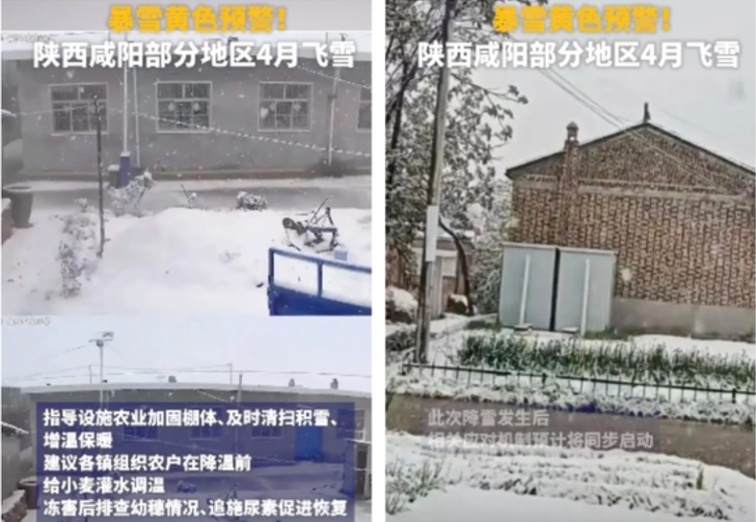
On the morning of April 21, 2026, heavy snow unexpectedly fell in Baoji, Tongchuan, and Xianyang in Shaanxi Province. (Screenshot from the internet)
[People News] June is typically the start of summer, but on the morning of June 1, 2026, residents in northern Genhe City, Inner Mongolia—including areas like Jinhou, Mangui, and Alongsan—opened their windows to find a blanket of white outside, with snow accumulation reaching 3 to 5 centimeters at its thickest, causing the landscape to instantly 'return to winter.' On the same day, snowfall was also recorded in the Daxing'anling region of Heilongjiang.
The phenomenon of 'June snow' has sparked significant discussion on social media, with many drawing parallels to the tale of Dou E, expressing that there are too many injustices in contemporary China.
According to the Tang Dynasty text 'Kaiyuan Zhanjing,' it is noted in 'Tianjing': 'If it snows in summer, there will be great mourning, and chaos will arise in the world.' The 'Shituiduozai' states: 'If one goes against heaven and earth, and violates human ethics, then it will snow in summer.' Jing Fang's 'Yihou' mentions: 'If it snows in summer, the country will suffer calamity, there will be mourning, and Sima will cause chaos. It also states: When the ruler dies, the country perishes.'
In essence, summer snow signifies two scenarios: one indicates that the country will face great mourning, often referring to the death of a monarch, which leads to the end of their dynasty. The other suggests that the current social conditions are in conflict with the natural order and violate moral principles.
Following the snowfall, Hebei also reported signs of disaster. On June 4, Gu'an County in Langfang was unexpectedly struck by severe hail, with the storm lasting about half an hour. The hailstones were dense, with the largest measuring the size of a small egg, and the accumulation on the ground reached about 10 centimetres at its thickest. Videos showed what appeared to be snow, and within minutes, it formed a white ice river. A 39-year-old resident remarked that it was the first time he had witnessed such an event in his life.
On the afternoon of the same day, Shenzhou City in Hebei's Hengshui and Baoding were also struck by hail. In Baoding, farmers suffered losses exceeding 200,000 yuan as their watermelons were destroyed by the hail.
At 4 PM on the 4th, heavy rain and hail swept through the Tongzhou District of Beijing, with intense rainfall and dense hail, the size of which was slightly smaller than a ping-pong ball.
Dong Zhongshu, who introduced the concept of 'heavenly-human response' during the Western Han Dynasty, believed that 'hail represents the yin energy threatening the yang.' The Tang Dynasty's 'Kaiyuan Divination Classic' interprets this disaster as follows:
Jing Fang, a prominent scholar from the Western Han's 'Book of Changes,' stated: 'When hail is excessively large, the ruler dislikes hearing about their faults, suppresses the virtuous, and does not share power with them; thus, the petty gain benefits.' Essentially, this means that when hailstones are too large, it signals that the ruler (or those in high positions) is averse to acknowledging their mistakes, stifles capable individuals, and denies them high positions, allowing the petty to profit from the situation.
The 'Emotion Symbol' notes: 'When ministers abuse their power, hail will fall.' This indicates that the descent of hail signifies that powerful officials (ministers) have privately manipulated, misinterpreted, or monopolised the nation's laws and systems, transforming public law into a means for personal gain and consolidating their power.
Jing Fang also posited that when unusual weather brings hail, it often reflects political and social disorder. He stated: 'When hail falls, it may destroy roofs, damage vehicles, and kill livestock; this occurs because the ruler employs petty individuals and punishes the populace. When hail strips trees of their branches and harms crops, it is due to the ruler's oppressive taxation, leading to violence among the people.'
The interpretation is as follows: when hail falls from the sky, destroying tiles, damaging vehicles, and killing livestock, it symbolises that the monarch places trust in the unscrupulous and relies heavily on slanderous ministers, thereby suppressing and sidelining honest and virtuous individuals. If the hail strips branches and damages crops, it foreshadows that the ruler imposes harsh taxes and levies, forcing the common people into desperate situations, which can even lead to tragic loss of life.
Jing Fang also conducted an extremely detailed classification of different forms of hail for divination purposes, using this to caution those in power to cultivate virtue and reflect on their actions, in order to guard against potential rebellion from subordinates or social unrest.
For instance, if the hail resembles accumulated snow or standing water, it is a sign of subordinates plotting to assassinate the ruler. The hail observed in Gu'an County, Langfang, Hebei, fits this description; does it not suggest that despite all precautions, one cannot escape the fate of assassination?
If the hail takes on a shape resembling snow with horns, or appears like beads, this indicates that the monarch is intent on causing harm, and the severity of this intent is significant.
If the hail resembles the fruit of a pear, it signifies that the monarch is disturbing the populace and governing with extreme cruelty, leading to deep-seated resentment.
If hail falls alongside strong winds, it serves as a severe punishment and warning from heaven regarding the chaotic governance of the monarch, excessive decrees, or the potential for social unrest.
At present, in China, one might wonder if the situation aligns with the predictions made by our ancestors a thousand years ago: despite the Communist Party leader's incompetence in governance, he favours flattery and disregards capable individuals. This has led to the rise of sycophants, such as Cai Qi, who are given power and misuse public law to harm the populace. Additionally, amid the economic decline, the burden of excessive taxes and fees remains unchanged, forcing more people into desperation, with tragic events occurring repeatedly across the country. Public discontent is reaching a boiling point, and many are yearning for the fall of the Communist Party.
In Gu'an County, Langfang, Hebei, the hail has taken on shapes reminiscent of snow accumulation and standing water, echoing the messages conveyed by various recent celestial phenomena. Could this not suggest that no matter how much Xi (Xí) tries to protect himself, he cannot evade the fate of assassination?
(First published in People News) △




News magazine bootstrap themes!
I like this themes, fast loading and look profesional
Thank you Carlos!
You're welcome!
Please support me with give positive rating!
Yes Sure!