

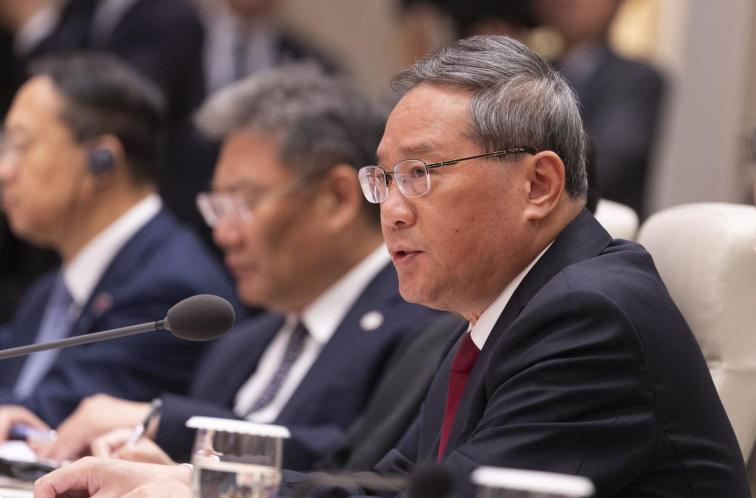
The picture shows Cai Qi, a member of the Politburo Standing Committee of the Chinese Communist Party, attending the National People's Congress on March 12, 2023. (Screenshot from the web)
[People News] Recently, the authorities finally confirmed earlier rumours: Xia Linmao, a member of the Standing Committee of the Beijing Municipal Party Committee and executive vice mayor of Beijing, has been placed under investigation while still in office.
Xia Linmao was no ordinary official. He was a trusted aide and key subordinate of Cai Qi, the current member of the Standing Committee of the Political Bureau of the Chinese Communist Party (CCP) Central Committee, during Cai’s tenure as Beijing’s top leader. According to reports, Xia’s case has far-reaching implications. He was not only closely connected to several key figures involved in the case of Ma Xingrui, a former member of the Political Bureau, but there have even been rumours that he was implicated in matters involving Cai Qi’s son, Cai Erzjin.
It should be noted that Cai Qi is now virtually the second-most powerful figure in the CCP’s officialdom, second only to one person. Yet even a powerful patron of his stature dares not step forward to protect his former subordinate. This has once again allowed people to see that the infighting within the CCP’s officialdom is far more brutal than most people imagine.
The Central Commission for Discipline Inspection (CCDI) has officially announced that Xia Linmao, a member of the 20th Central Committee as an alternate member and a deputy to the 14th National People’s Congress, is under investigation for “suspected serious violations of discipline and law.”
Looking back at Xia Linmao’s career, he spent many years establishing himself in Beijing’s planning and local government systems. During Cai Qi’s tenure as Beijing’s top leader, Xia was promoted repeatedly. He successively became secretary of the Dongcheng District Party Committee and a member of the Beijing Municipal Party Committee’s Standing Committee, as well as secretary of the Education Work Committee. After the 20th Party Congress, he advanced further to the position of executive vice mayor. He was widely regarded as a core member of Cai Qi’s “Beijing faction.”
The sudden purge of such a once-prominent political star has sent several powerful political signals to the outside world:
First, the purge has no blind spots whatsoever, and the so-called “protective umbrella of trusted associates” is nothing but an illusion.
Many people previously believed that as long as they entered the inner circle of the supreme leader or attached themselves to a powerful and influential Politburo Standing Committee member like Cai Qi, they would receive an “immunity pass.” Xia Linmao’s fate has directly punctured this illusion: within the system, there is no truly safe zone.
Once the leadership decides that an official is “politically disloyal” and determines to target him, the supervisory system can be mobilised instantly. In a system where “no official is free from corruption,” finding leverage over an official is exceedingly easy. Political charges may be difficult to state openly, but it takes little effort to find some financial irregularities and use them to pile on a whole host of accusations.
This kind of “clipping the wings” operation also serves, objectively, as an implicit warning to powerful officials close to the dictator, including Cai Qi. It constantly reminds everyone that power is granted by the central authorities, and no one should imagine that they can establish their own private sphere of security.
Second, Beijing’s “core of power and interests” is undergoing another major reshuffle.
As China’s political centre, Beijing is home to enormous networks of political and business interests behind urban planning, land development, and construction projects, such as the Beijing Municipal Administrative Centre.
Xia Linmao had long wielded considerable power over Beijing’s planning authorities, Dongcheng District, Miyun District, and the city’s administrative sub-centre. Before him, several senior Beijing government officials had already fallen, including former vice mayor Gao Peng and Beijing Municipal Committee of the Chinese People’s Political Consultative Conference chairman Wei Xiaodong. This indicates that the authorities’ purge of Beijing’s senior bureaucratic networks has entered deep waters. Whether one is a longtime local power broker or a newly promoted political star, everyone is within the reach of the investigation teams.
Third, the succession pipeline and alternate members of the Central Committee are facing a collective reshuffle.
In recent years, multiple members and alternate members of the 20th Central Committee have fallen from power, including figures from the military, state-owned enterprises, and local governments. This reflects the fact that the bureaucratic ranks assembled after the 20th Party Congress are undergoing frequent elimination and purges.
Xia Linmao holds a doctorate from Tsinghua University. As both a technocrat and a former top local official, he was originally regarded as a promising candidate in the leadership succession pipeline. His downfall demonstrates that even the most intense anti-corruption scrutiny cannot prevent officials from engaging in corruption and maintaining a double-faced public persona. Instead, it leaves the entire pool of senior cadres in a constant state of instability and mutual distrust.
Fourth, insecurity within the bureaucratic system has reached an extreme, prompting officials collectively to lie low and protect themselves.
Just days before Xia Linmao was taken away, on October 14, he was still accompanying the Beijing Party Secretary at a meeting with foreign guests as usual. Yet in the blink of an eye, he was reportedly taken away without warning after his home was raided. This pattern of senior officials suddenly falling from power while still in office has sent shockwaves throughout the ranks of provincial- and ministerial-level officials.
Xia Linmao’s downfall has made senior officials even more aware that no matter how loudly they chant the slogans or how closely they follow the political line, they can be discarded at any time. This extreme uncertainty is forcing mid- and high-level officials to adopt a completely defensive approach to their daily governance: refusing to take responsibility, avoiding crossing any lines, and responding to tasks perfunctorily. There is no alternative. To protect themselves, they would rather simply do nothing.
Xia Linmao’s downfall once again confirms that within the CCP’s officialdom, this bureaucratic meat grinder, no official is absolutely safe. Even Cai Qi, who wields enormous power, dares not reach out to protect his own subordinates, for fear that the flames might spread to him. This is a classic case of “political purges without distinction.”
There Is a Secret Remedy for Escaping the Fate of Becoming a “Sacrifice to the Party Flag”
It sends an extremely harsh signal: under the operation of an authoritarian machine, no faction, prestige, or background can serve as a genuine “insurance policy.” This purge machine has become impossible to stop. Driven by its own momentum, it continues to subject the system to internal high-pressure purges and self-consumption, and any official could become the next sacrifice at any moment.
Over the past decade or so, the internal purges carried out in the name of anti-corruption have revealed a profoundly ironic political paradox: when this bureaucratic meat grinder operates at full intensity, no one within the CCP system—from low-level clerks to the highest ruler—can obtain any genuine sense of security.
On the surface, an authoritarian dictatorship concentrates power to an extraordinary degree, with political control and social surveillance reaching unprecedented levels of intensity.
In reality, however, the system has fallen into a vicious cycle of “suspicion → purges → insecurity → further purges” because of the absence of the rule of law and mutual trust. From the supreme ruler to provincial- and ministerial-level officials, and even to the most basic village-level cadres, everyone lives in fear.
This toxic state of “universal insecurity, bureaucratic inaction, and internal systemic attrition” is steadily hollowing out the country’s governance capacity and economic foundations. This is also why problems are accumulating across China’s economy, culture, education, healthcare, social welfare, and other fields. These problems seem completely intractable, while ordinary people are increasingly losing hope.
Many historians and political scholars have pointed out that the eventual collapse of such authoritarian systems often does not result from external attacks, but rather from frenzied internal infighting and the system reaching a critical breaking point.
Meanwhile, Xi Jinping, the CCP leader, has substantially depleted the CCP’s accumulated resources, institutional trust, and bureaucratic execution capacity through extreme centralisation of power and internal purges. Xi has been dubbed the “great accelerator” by outside commentators. He may well be the final CCP leader whom current-affairs commentators describe as having a mission to “destroy the Communist Party from within.”
For officials within the system, the most effective shortcut to saving their lives and escaping the tragic fate of becoming a “sacrifice to the Party flag” is to quit the Communist Party. This means declaring the “Three Withdrawals”: withdrawing from the CCP, the Communist Youth League, and the Young Pioneers.
Among overseas communities and observers, claims that the descendants of senior officials and members of the privileged elite have registered their withdrawals from the Party and affiliated organisations under pseudonyms or their real names on Three Withdrawals websites have circulated widely. Officials who have not yet made their withdrawals should stop hesitating and act quickly. After all, no one can predict the day when the bureaucratic meat grinder will turn its attention to them.
(First published by People News.) △





News magazine bootstrap themes!
I like this themes, fast loading and look profesional
Thank you Carlos!
You're welcome!
Please support me with give positive rating!
Yes Sure!