
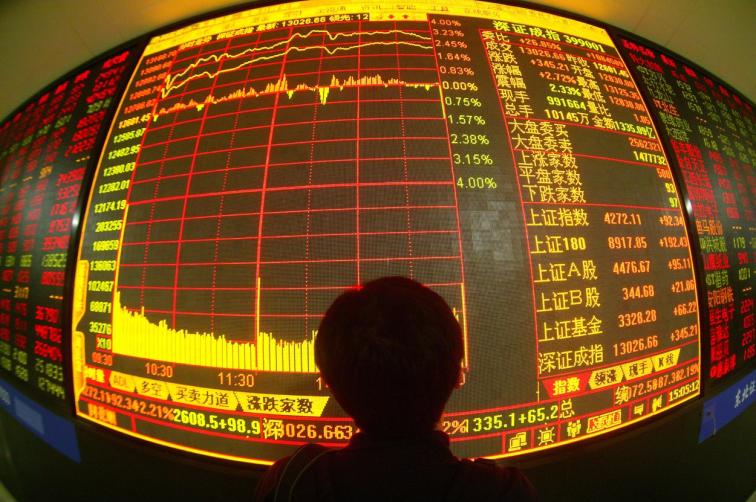
Photo caption: Recently released May financial data once again confirms the grim state of China's economy. (Photo by China Photos/Getty Images)
[People News] A politically charged saying has long circulated among the Chinese public and in overseas Chinese communities: "In CCP media, the only truth is the date; everything else is fabricated." There is even a popular belief that "official achievements are exaggerated, and official data should be viewed with caution."
These expressions are essentially a form of political satire or folk humour, reflecting the widespread distrust among the Chinese populace towards the CCP's official media and administrative bodies. This scepticism arises from the CCP's effective propaganda tactics, which involve falsification and brainwashing the public by presenting lies as truths. Under the pressure of performance evaluations, local officials often embellish the data and achievements they report to safeguard their positions.
Xi is Familiar with Performance Falsification
Both Xi Jinping and Cai Qi have extensive experience in local governance. Xi Jinping has been involved in local politics since 1982, when he was transferred from the Central Military Commission Office to various local roles, including county party secretary, mayor, and provincial governor. He is well-acquainted with the tactics local officials use to mislead the Party Central Committee, understanding that there may be a tendency for local reports to "highlight good news while downplaying bad news" or present distorted data.
Cai Qi also possesses significant experience in local governance. Therefore, it is not surprising that recent reports indicate that Cai Qi, the Director of the General Office of the CPC Central Committee, submitted an internal economic report to Xi Jinping that bypassed the National Bureau of Statistics and established an independent data investigation system, indicating that the CCP leadership has lost trust in official statistical data.
Cai Qi Initiates New Efforts to Investigate Authentic Data
Recently, Du Wen, the director of the legal advisory office of the Inner Mongolia government, revealed in a program on his personal channel that Cai Qi seldom utilises data from the National Bureau of Statistics when reporting economic matters to Communist Party leader Xi Jinping. 'In several reports submitted by Cai Qi to Xi Jinping, only one relatively minor economic data point relied on statistics from the Bureau.'
Du Wen explained, 'So, where does Cai Qi's data originate? He has his own survey team that directly conducts various statistical work.' This suggests that 'the data from the National Bureau of Statistics is no longer considered a reliable reference within the Communist Party.' Du Wen stressed that the data he mentioned 'is not an external estimate, but the actual economic data that Xi Jinping is presented with.'
Du Wen noted that Chinese society currently displays several clear characteristics: official data still indicates growth, yet the public's perception is increasingly negative; banks seem stable on the surface, but the real economy is critically short of cash; cities have not experienced sudden collapses, but commercial streets remain consistently vacant; foreign investment has not completely exited, but new investments are continuously declining.
He stated, 'Residents are reluctant to borrow money, businesses are hesitant to expand, banks are cautious about lending to private enterprises, and local governments can only continue to borrow to stay afloat.' In his view, this signifies 'monetary easing, but social confidence has already crumbled.'
Du Wen believes that the fundamental issue confronting the Chinese economy is that 'the highly centralised system, which lacks the rule of law and property rights protection,' can no longer sustain a modern market economy. A market economy fundamentally requires property rights security, judicial independence, policy stability, and information transparency, yet 'today's China has regressed significantly in all these aspects.'
The most prominent fraud cases in recent years.
For many years, China's economic and social statistical data have attracted significant attention from the international community. This is particularly true under the system where the Chinese Communist Party uses 'performance evaluation' as a crucial criterion for the promotion of officials. As a result, local governments have faced long-standing accusations of 'data inflation' and 'reporting only good news while hiding bad news.' Below are some of the most prominent cases and their relevant backgrounds in recent years.
1. Local GDP Inflation
One of the most striking and representative cases in recent years involves local governments being officially named for 'GDP inflation.'
1. Inner Mongolia: Industrial Data Inflated by 40%
In 2018, Inner Mongolia publicly acknowledged that some economic data had been falsified for an extended period. Officials revealed that the industrial added value had been inflated by approximately 40%, and fiscal revenue had also been exaggerated. The local government admitted, 'Some regions and departments have manipulated economic data.'
Observers believe that local officials, in their efforts to meet GDP and investment growth targets, have created a misleading impression of 'economic prosperity' by inflating corporate output and fiscal revenue.
2. Tianjin Binhai New Area: GDP Inflated by One-Third
Tianjin's Binhai New Area was once promoted by officials as 'China's Manhattan.' However, officials later admitted that the regional GDP had been overestimated by more than one-third.
This revelation shocked the public, as Binhai New Area was originally a key demonstration zone developed by the central government. Commentators argue that if even the official model area can be significantly inflated, the credibility of local statistics is inevitably called into question.
2. Youth Unemployment Rate 'Too Distressing' to Publish (2023)
In 2023, China's youth unemployment rate surged to 21.3%. However, just as public concern was mounting, the National Bureau of Statistics of China abruptly announced that it would suspend the release of youth unemployment data. The official explanation was that there was a need to 'optimise statistical methods.'
This decision immediately ignited controversy among international media and economists. Critics contend that when the data is unfavourable, the response is to cease publication. Following this, the authorities redefined the statistical criteria by excluding currently enrolled students and altering the calculation method for youth employment. Consequently, the reported figures dropped significantly, but many observers believe this constitutes a 'technical adjustment' that fails to accurately reflect the real employment challenges facing young people.
3 'Digital Governance' and New Performance Projects
In recent years, numerous local governments have proclaimed significant increases in new energy output, the emergence of high-tech parks, and record agricultural production.
However, it was later revealed that the actual situation was quite different: factories were shutting down, parks were left vacant, and some even resembled 'ghost town-style industrial parks.' Some commentators argue that these so-called achievements are merely 'ten thousand jin per mu in the new era,' suggesting that the Chinese Communist Party's practice of fabrication has never ceased.
4 Controversy Over COVID-19 Death Toll
At the end of 2022, after China lifted its 'zero-COVID policy,' the pandemic spread rapidly. Nevertheless, the official narrative for an extended period was that the COVID death toll remained extremely low. Concurrently, many regions in China reported overwhelming crematoriums, long queues at funeral homes, and congested emergency rooms in hospitals, with such images widely shared on social media. Unsurprisingly, many of these videos were swiftly ordered to be removed by the authorities.
However, several international research institutions have estimated, based on factors such as excess mortality models, cremation capacity, population changes, and medical burden, that the actual number of deaths in China due to the new coronavirus infection could be significantly higher than the official statistics. This situation has been viewed by some scholars as one of the most severe 'data credibility crises' in China in recent years. △







News magazine bootstrap themes!
I like this themes, fast loading and look profesional
Thank you Carlos!
You're welcome!
Please support me with give positive rating!
Yes Sure!