
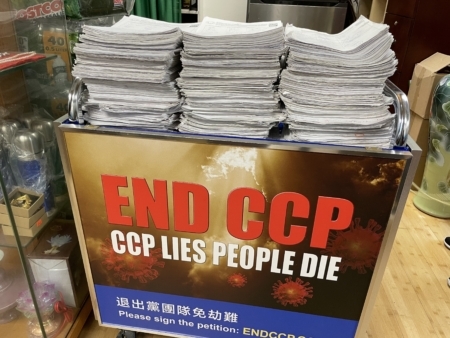
Signed petitions for the ‘End CCP’ initiative, filling up a small cart. (Provided by the Tuidang Centre)
[People News] According to reports from mainland media, on May 28, Liu Weiwei, a prominent figure in the Chinese vocal music scene known for his lyric spinto tenor, passed away at the age of 69 due to illness in Yangzhou. He had served as the principal soloist at the Central Opera House and the Oriental Song and Dance Troupe, and was the head of the opera department at the Central Academy of Drama.
In the early hours of May 29, the renowned actor and director Cai Yuanyuan, who played the role of Haiwa in the revolutionary film "Chicken Feather Letter," died in Macau at the age of 84.
Both of these recently deceased figures in the mainland art world had previously lent their support to the Communist Party.
Liu Weiwei, a graduate of the Central Conservatory of Music, was highly accomplished in the arts. According to statements from the Communist Party's official media, his voice was bright and clear, his singing style was grand, and he had a strong stage presence, combining artistic appeal with a rich sense of national aesthetics. In addition to participating in numerous opera performances, Liu Weiwei also took part in many large-scale concerts, including Mahler's "Das Lied von der Erde" and others.
Moreover, Liu Weiwei frequently collaborated with Xi Jinping's wife, Peng Liyuan, in large cultural gala performances and music festivals. For instance, they performed together as guest artists in the Communist Party's glorifying "Song of the Chinese Revolution," during the celebration of Macau's return, and at various cultural ministry Spring Festival galas.
In 2016, Liu Weiwei performed "Motherland, My Kind Mother" on the CCTV program "Chinese Arts." In April 2024, he participated in a performance by the old soldiers' art troupe of the Eighth Route Army of the Communist Party, where he sang the revolutionary song "The Sun That Never Sets on the Prairie" among others.
Liu Weiwei's selection as a member of the 11th National Committee of the Chinese People's Political Consultative Conference is likely attributed to his contributions and embellishments.
Cai Yuanyuan, born in 1942 in Jiang'an, Sichuan, began his journey in the film and television industry at the age of seven when he appeared in the film 'Biao', directed by Huang Zuolin, playing the role of 'Little Mouse'. In 1953, he portrayed 'Haiwa' in the red film 'Jimaoxin', directed by Shi Hui, which became one of the iconic images in the history of Communist Party cinema. However, upon closer examination, one might question the logic of entrusting critical military intelligence (represented by three chicken feathers) to a child under ten (Haiwa) for delivery, especially with the narrative of 'a father risking his son's life to deliver a message'.
Indeed, films like 'Jimaoxin', 'Little Soldier Zhang Ga', and 'Ditch Warfare' are classic red films that the Communist Party of China (CPC) used to mobilise minors for its political and military agendas. The aim was to reinforce political indoctrination and ideological education for future generations by depicting young heroes.
While Cai Yuanyuan may have initially served the CPC passively in his youth, his admission to the directing department of the Beijing Film Academy in 1960 marked a shift to active service for the CPC. After graduating, he worked at the Changchun Film Studio and the Zhujiang Film Studio, directing films such as 'Synthetic Wool', 'Reef', 'Wedding on the Execution Ground', and 'Lanterns and Festivities', all of which served to enhance the CPC's image.
It may be a coincidence, but in 1989, the year of the 'June Fourth' tragedy, he relocated to Macau and directed several works, including 'The Night Thief of the Tomb of the Concubine' and 'The Temptation of the Long Braid'. The latter tells a complex love story between a young Portuguese nobleman and a Chinese water girl living in a commoner's neighbourhood, and is considered a milestone in the development of local cinema in Macau.
In 2003, Cai Yuanyuan played a key role in bringing the seventh 'Cross-Strait and Hong Kong Film Directors Seminar' to Macau, and he has participated multiple times in cultural exchanges related to film between mainland China, Hong Kong, Taiwan, and Macau.
In December 2021, he served as the chief director of the theatrical film 'A Dream of Guling for an American', with Ye Ting's son Ye Zhengguang as the chief planner. The film is set against the backdrop of a speech made by Xi Jinping, then Vice Chairman of the Communist Party of China, in the United States in 2012, where he shared the 'Guling story'. This story involves the long-standing connection between the American Gardner family and China, as well as Gardner's regret and longing for not being able to return to Guling, Fujian, during his lifetime. This narrative has also been a favourite topic for Xi on various occasions. It is evident that this film serves as a typical piece of Communist Party propaganda.
While Liu Weiwei and Cai Yuanyuan are both highly skilled in their respective fields, under the influence of the Communist Party's brainwashing and manipulation, they support the Party. In the context of the era of 'Heavenly Punishment for the Communist Party', are they not also complicit in wrongdoing, thus diminishing their own fortunes? Such instances have become increasingly prevalent in recent years, and while they are disheartening, do they not also invite deeper contemplation?
(First published in People News) △





News magazine bootstrap themes!
I like this themes, fast loading and look profesional
Thank you Carlos!
You're welcome!
Please support me with give positive rating!
Yes Sure!