

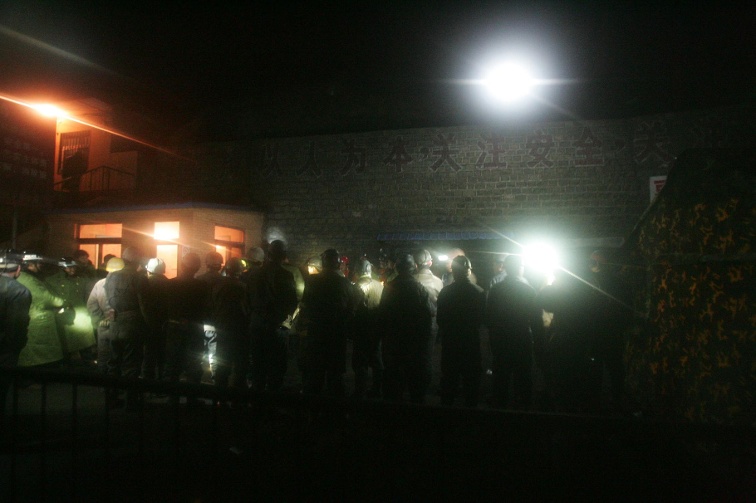
Coal mine workers (made by ChatGPT)
[People News] A gas explosion occurred on the evening of May 22 at the Liushenyu Coal Mine operated by Tongzhou Group in Qinyuan County, Shanxi Province. On the evening of the 23rd, officials announced that the incident had resulted in 82 fatalities, 2 individuals missing, and 128 injuries. However, the official numbers for deaths and missing persons changed multiple times from the moment of the accident until the press conference, raising doubts about the accuracy of the casualty figures. This incident marks the largest mining disaster in China in 17 years.
As reported by Radio Free Asia, the official casualty figures shifted several times within just over ten hours following the accident. Rolling updates from Xinhua News Agency indicated that by 3:33 AM on the 23rd, 157 individuals had been rescued from the mine, 4 were confirmed dead, and 90 remained underground, with 16 in critical condition. By 6 AM on the 23rd, the Qinyuan County Emergency Management Bureau reported that out of 247 workers still underground, 201 had safely emerged, 8 were deceased, and 38 were still undergoing rescue operations. Based on these figures, there were still 46 individuals unaccounted for at that time.
On the afternoon of the 23rd, officials announced that the death toll had risen to 82. CCTV News later reported that the accident had claimed 90 lives. However, that evening, officials revised the figures to indicate that 82 people had died and 2 were missing. The authorities' frequent adjustments to the casualty numbers have sparked scepticism regarding the true nature of the incident. On the 23rd, China News Network raised questions, stating, 'Why is the company unclear about the number of workers in its own coal mine? Is there human intervention in the data collection and reporting process that warrants further investigation?' During a press conference, officials explained that the chaotic scene following the accident led to the company's confusion about the number of workers, resulting in inaccurate initial reports.
The death toll from the mining accident has been inconsistent.
Lu Jun, a scholar specialising in coal mine explosions in China, told Radio Free Asia this Monday that the frequent occurrence of such production accidents is attributed to the absence of independent labour unions. He remarked, 'From the news, it is evident that the producers, or the capital side, are completely indifferent to production safety. The floor plans do not even correspond to the actual conditions, and they do not permit the unauthorised opening of blocked tunnels.'
Lu Jun noted that workers have long recognised these high-risk practices, but due to their vulnerable position, they lack the means to express their concerns.
State media reported that the blueprints provided by the Liushenyu Coal Mine do not align with the actual conditions, forcing rescuers to search and rescue one tunnel at a time.
Liu Lei, a scholar from Beijing, informed reporters that under China's current accident classification system, any incident involving more than 30 individuals is categorised as a particularly serious accident, which could lead to accountability for key officials at both provincial and municipal levels. Additionally, concealing or misreporting the incident could result in criminal charges. 'In many regions, following a major accident, the immediate response is often to control the reported death toll. Initially, they reported 8 fatalities and 38 missing persons, which suggests they may have intended to hide the truth. Previously, in Shanxi, there were instances of concealment; I recall a water inrush incident where they spent 8.5 million yuan to settle privately with four families, and another 3.5 million yuan to silence one family. However, this time, it seems unlikely they can cover it up; there is widespread scepticism.'
On Sunday, reporters attempted to contact the emergency management bureau of Qinyuan County to gather information about the casualty figures, but their calls went unanswered.
According to reports from CCTV News and the Beijing News, a miner involved in coal transportation stated that the accident occurred during the shift change when miners were descending into the mine, with most local miners hailing from Qinyuan and Qinxian. A survivor recounted that out of 20 individuals in his two teams, only 4 managed to escape, while many others were rendered unconscious by the explosion's shockwave.
Gao Wenxiang, a commentator focused on mining accidents in China, emphasised to reporters that the most critical elements in mine rescue operations are the tunnel maps and ventilation system diagrams. Discrepancies between these diagrams and the actual conditions can significantly impact assessments of gas and toxic gas dispersal.
He remarked, 'Some coal mines adjust their mining areas informally to boost production, but the diagrams submitted to regulatory bodies are not updated accordingly. This issue is quite prevalent in the coal mining sector.'
The coal mine in question has faced multiple fines in the past.
Public information indicates that the Liushenyu Coal Mine is part of the Shanxi Tongzhou Coal and Coke Group, which was established in 2010 and has an approved production capacity of 1.2 million tons per year. In 2024, the National Mine Safety Supervision Bureau of China included this mine in the 'National List of Coal Mines with Severe Disaster Risks', primarily due to the risk of 'high gas'.
As reported by China News Network, in 2025, Liushenyu Coal Industry received two administrative penalties for various violations, including workers entering the mine without wearing reflective clothing, failure of emergency stop protections, and the roof collapsing without implementing reinforcement measures.
In 2023, during a law enforcement inspection by the Shanxi Provincial Emergency Management Department, significant safety hazards were identified at the mine, such as water hazards and exposed copper wires, resulting in penalties for both the company and its responsible officials.
Mr Liu, a rights protection activist from Shanxi, commented to reporters: 'Currently, many coal mines are operating while simultaneously addressing safety issues. Local finances, employment, and tax revenues are all linked to coal mines. Particularly in the last two years, the government has suddenly stressed the need to ensure coal supply, so many mines will not easily halt production even if there are safety concerns.'
Frequent Mining Accidents in China
On the 23rd, Xinhua News Agency reported that the State Council's accident investigation team will conduct an investigation into the Liushenyu Coal Mine accident to determine the cause and the responsibilities of the company, regulatory bodies, and local authorities.
In November 2009, a gas explosion at the Xinxing Coal Mine in Hegang, Heilongjiang, resulted in 108 fatalities. In February 2023, a significant collapse occurred at the open-pit coal mine operated by Xinjing Coal Industry in Alxa League, Inner Mongolia, leading to 53 deaths and 6 injuries.
△





News magazine bootstrap themes!
I like this themes, fast loading and look profesional
Thank you Carlos!
You're welcome!
Please support me with give positive rating!
Yes Sure!