
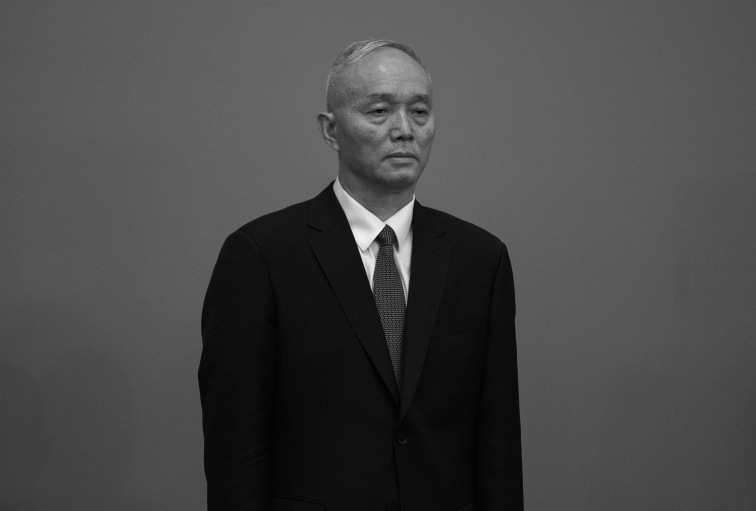
File photo: On October 23, 2022, Politburo Standing Committee member Cai Qi attends a press conference at the Great Hall of the People with other newly appointed Standing Committee members and both domestic and international journalists. (Photo by Kevin Frayer/Getty Images)
[People News] As the 21st National Congress of the Communist Party of China approaches, the personnel structure within the Party is undergoing a significant reshuffle. Cai Qi, who serves as the de facto number two figure in the Party and the foremost power broker within Xi Jinping's inner circle, has his political fate closely intertwined with Xi Jinping's personal authority. Since 2026, the political dynamics surrounding Cai Qi have revealed a dual trend of concentrated power and an escalating risk of incidents involving his close associates. This has led to a complex and divided interpretation of his political standing by external observers. Moving forward, Cai Qi's political variables and risks will coexist, further heightening the dramatic perceptions regarding the stability of the Zhongnanhai regime.
According to a report from the party media Xinhua News Agency, on June 5, the Central Party School of the Communist Party of China held a graduation ceremony for the second batch of classes for the spring semester of 2026, which was attended by President Cai Qi. On May 15, during the opening ceremony for the second batch of training classes for the same semester, the then-president Chen Xi was present. This indicates that within a mere 20 days, the leadership of the Central Party School, the highest institution of the Communist Party, has quietly changed hands, with Chen Xi stepping down and Cai Qi taking over mid-term.
Cai Qi has replaced Chen Xi, who had been serving at the Central Party School for nine years, signalling that Chen Xi, a member of the Tsinghua faction, is officially starting to withdraw from Xi Jinping's inner circle of trusted allies. This change is likely connected to the recent issues faced by other former officials from Tsinghua and the Organisation Department, including former Minister Li Ganjie, former Deputy Minister of the Propaganda Department Zhang Jianchun, and former Deputy Minister of the Organisation Department Peng Jinhui. Additionally, there are rumours that the current Minister of the Organisation Department, Shi Taifeng, might be appointed as the president of the Central Party School. However, it seems that Xi Jinping has limited confidence in Shi Taifeng, ultimately leading to Cai Qi's appointment as the president of the Central Party School.
Some analysts have remarked that this move represents a revival of the Communist Party's tradition of having a Standing Committee member also serve as the president of the Central Party School. While this may appear to be the case at first glance, Xi Jinping's approach to power does not conform to any established party traditions or customs; instead, it reflects a coincidence of power dynamics and established practices. What is particularly significant and likely to provoke debate is Xi Jinping's choice to position Cai Qi in the presidency of the Central Party School. What is the underlying purpose of this decision, and what deeper meanings might it carry? Is it a test of loyalty or a step towards further power consolidation? Is it a strategy for Cai Qi's concentration of power, or a warning that he may be ousted from the Politburo, signalling a loss of influence?
Since taking the helm of the Central Party School, Cai Qi has emerged as a figure of immense influence, ranking just below one person and above countless others. Within the political hierarchy of the Chinese Communist Party (CCP), he is regarded as the most powerful minister in history: he holds the fifth position in the Politburo Standing Committee, is the first Secretary of the Central Secretariat, and serves as the Director of the General Office (overseeing the Central Security Bureau), Secretary of the Central and State Organs Work Committee, and Leader of the Central Party Building Work Leading Group. Additionally, Cai Qi is the Vice Chairman of the National Security Commission and the Director of the Cyberspace Administration, effectively becoming the key decision-maker in national security and core strategic matters. Thus, Cai Qi has consolidated a range of core powers, including control over party affairs, ideological direction, organisational personnel, cadre training, and talent selection.
Cai Qi oversees the execution of party affairs, ideology, organisational personnel, cadre training, and core information security and review processes. In 2026, he was frequently present at national meetings for propaganda ministers, organisational ministers, and social work ministers, engaged with figures in the cultural and technological sectors, participated in the discussions of the Two Sessions, and met with delegations from the United States, Serbia, Vietnam, and others, often representing Xi Jinping or accompanying him, showcasing his core executive capabilities. His leadership of the Central Party School undoubtedly aids Xi Jinping in reinforcing ideological control and restructuring the reserve cadre system.
However, following the expansion of power, Cai Qi is bound to provoke Xi Jinping's suspicions regarding the safety of his own authority. Given Xi Jinping's personal tendencies towards an excessive attachment to power and a suspicious nature, it is unlikely that Cai Qi will be an exception. After Xi Jinping's removal of Zhang Youxia (Zhāng Yòuxiá), his standing within the military did not become more secure; instead, it remained in a state of uncertainty and turmoil. The more uneasy Xi Jinping becomes, the more he feels compelled to purge the military, which in turn causes military morale to drift further away from him, resulting in a deadlock and a vicious cycle. In theory, Cai Qi, who holds excessive power, has the potential to overthrow Xi Jinping, and this possibility is not entirely absent in reality. Previously, The Economist published an article on April 30 titled 'Cai Qi May Be China's Second Most Powerful Person,' which ignited discussions about whether Cai Qi could succeed Xi Jinping. Observations by foreign media regarding the power structure of the Chinese Communist Party (CCP) are often interpreted as signals that the CCP leadership is deliberately testing the waters on specific issues.
Nevertheless, Cai Qi is ultimately a power minister who was promoted by Xi Jinping himself and is currently his most trusted confidant. If the trust between the two were to fracture, it would imply that Xi Jinping would have no one left to rely on, and no one would express loyalty to him. The dependency between Xi Jinping and Cai Qi is, in a sense, a core pillar of the power structure in Zhongnanhai. This situation undoubtedly places Xi Jinping in a dilemma: excessive reliance and trust in Cai Qi carry the risk of him becoming too powerful and undermining Xi's authority. Conversely, if Xi Jinping were to treat Cai Qi with the same heavy-handedness he applied to Wang Qishan (Wáng Qíshān) and Zhang Youxia, it could lead to a collapse of loyalty within the core circle and pose a risk of disintegration of power in Zhongnanhai.
Following the arrest of Zhang Youxia, Cai Qi stands out as the only figure within the military and the party capable of challenging Xi Jinping. Consequently, managing the relationship with Cai Qi has become Xi Jinping's most secretive and pivotal political concern. An analysis of Cai Qi's current political movements suggests that Xi Jinping is employing a dual strategy towards him.
The first strategy involves continuously reshaping Cai Qi's role through the consolidation of power, allowing Cai Qi to further centralise his authority. In this context, Xi Jinping has demonstrated immense trust and reliance on Cai Qi, aiming to solidify support and secure Cai Qi's loyalty and commitment. The second strategy sees Xi Jinping taking action against Cai Qi's former associates and trusted aides. At the end of May and the beginning of June, Dong Guibo, the former party committee secretary and director of the Zhejiang Provincial State-owned Assets Supervision and Administration Commission, along with Gao Xingfu, the former vice governor of Zhejiang, both faced significant issues. Both individuals have strong connections to Cai Qi, being his former subordinates and confidants in Zhejiang. On June 6, Wei Xiaodong, the chairman of the Beijing Municipal Political Consultative Conference and a former member of the Beijing Municipal Committee and head of the Organisation Department, who managed personnel during Cai Qi's tenure in Beijing, was officially reported to have fallen from grace. Concurrently, the official website of the Beijing Municipal Political Consultative Conference has removed all historical information regarding Wei Xiaodong. A meeting in Beijing underscored the importance of maintaining absolute loyalty to the Central Committee of the Communist Party of China and firmly eliminating 'two-faced individuals.' Overseas media figure Jiang Wangzheng has disclosed that the Wei Xiaodong case could potentially impact Cai Qi.
Xi Jinping's recent arrest of Cai Qi's associates serves as a warning to Cai Qi, employing a strategy that combines both incentives and penalties, balancing benevolence with authority. While Cai Qi's political future is fraught with uncertainties and risks, the likelihood of a complete downfall remains low. At 71 years old this year, Cai Qi is unlikely to succeed Xi Jinping, especially given his lack of military background and control over the armed forces, which diminishes his qualifications as a successor. Furthermore, with Xi Jinping seeking re-election, there is little room for Cai Qi to ascend. As a key instrument of Xi Jinping's power, Cai Qi is unlikely to become a power broker himself, though a swift political demise seems improbable.
Xi Jinping has appointed Cai Qi as the president of the Central Party School, linking him to the long-term development within the Communist Party of China. This move is advantageous for Xi Jinping in managing reserve talent after his re-election. At the 21st National Congress in 2027, Cai Qi may either retain his position on the Standing Committee or be appointed as the chairman of the Chinese People's Political Consultative Conference, overseeing the United Front role. This dual role allows him to continue functioning as a loyal instrument while also enabling him to assist Xi Jinping in navigating challenges related to Taiwan's unification, potentially achieving significant outcomes.
Cai Qi's ascent to power is accompanied by inherent risks, reflecting the 'personal loyalty above all' paradigm characteristic of Xi Jinping's era. On one hand, Cai Qi has been entrusted with unprecedented authority over party affairs, organisation, propaganda, security, and execution, making him a crucial loyal tool for sustaining the regime's operations. On the other hand, this extreme reliance has fostered deep-seated trust issues and systemic vulnerabilities.
On the eve of the 21st National Congress, Cai Qi is likely to continue serving as a loyal political subordinate to Xi Jinping. However, the political variables and risks he faces highlight the structural challenges that the leadership of the Chinese Communist Party (CCP) encounters in terms of power succession arrangements, factional balance, and personal centralisation of authority. Ultimately, Cai Qi's ability to navigate this round of power reshuffling smoothly will depend not only on his unwavering loyalty to Xi Jinping but also on Xi's capacity to strike a balance between suspicion and dependence. This paradox of power within the logic of dictatorship is set to permanently entrap the political ecology of the CCP in a model akin to a power meat grinder.
(First published by the People News)△






News magazine bootstrap themes!
I like this themes, fast loading and look profesional
Thank you Carlos!
You're welcome!
Please support me with give positive rating!
Yes Sure!