
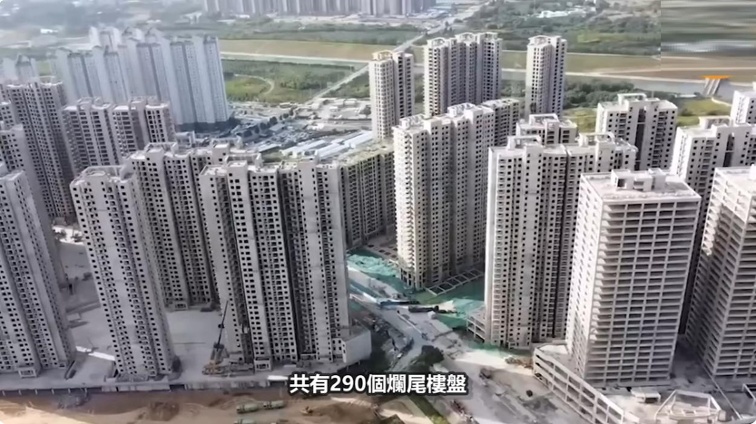
This image shows a stalled building in Zhengzhou, where 290 properties have been left unfinished, causing countless victims to endure hellish suffering. (Video Screenshot)
[People News] Recently, alarming data has emerged from China's real estate market, triggering panic among Communist Party officials. In the first half of this year, the number of homebuyers across China has sharply declined, leading to a significant reduction in the personal mortgage balances of major financial institutions.
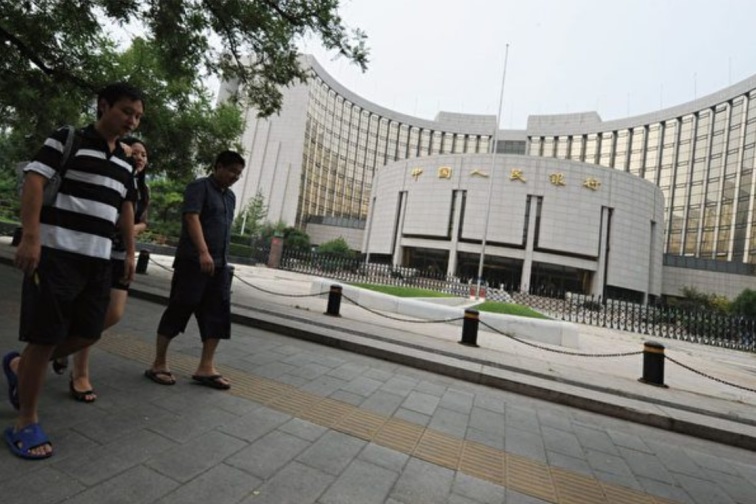
According to the latest data released by the People's Bank of China, in July of this year, household loans decreased by 460.3 billion yuan (RMB, hereafter the same), with medium- and long-term loans primarily for mortgages dropping by 120.2 billion yuan. Cumulatively, in the first seven months of this year, overall household loans decreased by 827.1 billion yuan, marking a year-on-year reduction of 1.5 trillion yuan.
When looking at a longer time frame, the annual growth rate of personal mortgage balances nationwide has shown negative growth for 13 consecutive quarters. What does this signify? It indicates that the number of people across China who are 'paying off their mortgages' and 'making early repayments' far exceeds those who are taking out new loans to buy homes. People are increasingly reluctant to jump into the fire pit of mortgage loans again.
Market Conditions: Second-Hand Housing Prices Plummet, Real Estate Companies Face Collective Losses.
The number of homebuyers has drastically decreased, leaving the housing market in a state of desolation. Previously, developers would hire dozens or even hundreds of people to queue at sales offices, creating a bustling atmosphere of 'bidding for houses' to entice potential buyers. But what about now? Even the tactic of hiring people is failing to attract buyers! There are now more actors in the sales offices than genuine house hunters; how can this charade continue? As a result, housing prices are plummeting like a kite with a broken string, falling without any limit.
According to the latest statistics, in August of this year, the prices of second-hand homes in 100 cities across China have dropped significantly, with a year-on-year decline of over 7%. Shockingly, 93 of these cities are witnessing falling housing prices! Industry experts indicate that second-hand homes, where buyers and sellers negotiate directly, most accurately reflect the true financial situation of ordinary citizens and the prevailing market sentiment. The widespread decline in second-hand home prices signals a complete loss of market confidence.
With houses unsold in the downstream market, the situation for real estate companies is even more grim. Among the more than 70 listed real estate firms that have released their semi-annual reports, over 70% are reporting losses, with total losses ranging from over 10 billion to more than 50 billion yuan in just six months.
Official new policies cannot restore market confidence.
In response to this seemingly endless housing market crisis, the authorities urgently introduced the so-called '8.28 New Real Estate Policy' at the end of August.
This new policy has two main points: first, it mandates that future transactions of commercial housing 'prioritize the sale of completed properties,' meaning they should only be sold after construction is finished, and it also extends the maximum personal mortgage term to 40 years; second, it eases financing for real estate companies, offering development loans with a maximum term of 7 years.
The government claims that selling existing homes allows buyers to "see what they get," thus preventing the re-emergence of unfinished buildings. However, the announcement of this new policy has been met with widespread ridicule online.
Netizens have expressed their frustrations: extending mortgage terms to 40 years—are we talking about "loan inheritance"? Buying a house at 30 and paying it off by 70, with retirement funds directly deducted by the bank? More importantly, it is clear to everyone that this policy addresses "future homes," while the millions of unfinished buildings quietly standing across the country remain unresolved. There are also millions of victims who are "in debt without a home"—are they expected to remain trapped in the cycle of paying off loans while renting, with the government ignoring their plight?
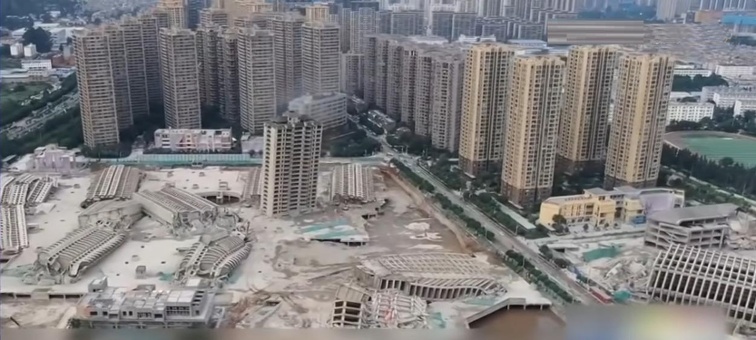
In 2022, in a certain area of Yunnan, 15 unfinished buildings were demolished in just 15 seconds. (Video screenshot)
Why are the authorities reluctant to intervene and rescue these unfinished buildings?
At this point, many people might wonder: since unfinished buildings are the primary cause of eroding market confidence, why doesn’t the government simply allocate funds to complete all the unfinished buildings across China and hand them over to the public?
There are actually four significant barriers to this:
The finances are severely lacking: to address the gap of approximately 250 million square meters of unfinished buildings nationwide, several trillion yuan in real funds would be required. Currently, local governments are unable to sell land, are heavily indebted from urban investment bonds, and are struggling to pay civil servants; if the central government were to print money to cover this, it could lead to inflation and a collapse of the yuan.
There is a significant moral hazard: if the government uses taxpayer money to complete these buildings, it would essentially mean covering the costs for real estate company owners who previously engaged in reckless expansion and transferred their assets overseas.
Ownership disputes have turned into a chaotic mess: unfinished projects frequently leave construction companies unpaid for their work and materials, and even the land has often been seized by the courts, leading to extreme confusion over property rights.
The authorities have opted for 'protecting the banks, not individuals': for officials, the current policy priority is to avert a collapse of the financial system, which translates to 'protecting the banks'. The new policy promoting the sale of existing homes is essentially a form of 'risk isolation', meaning that future risks are severed, while the already broken pieces of the past must be endured by ordinary citizens.
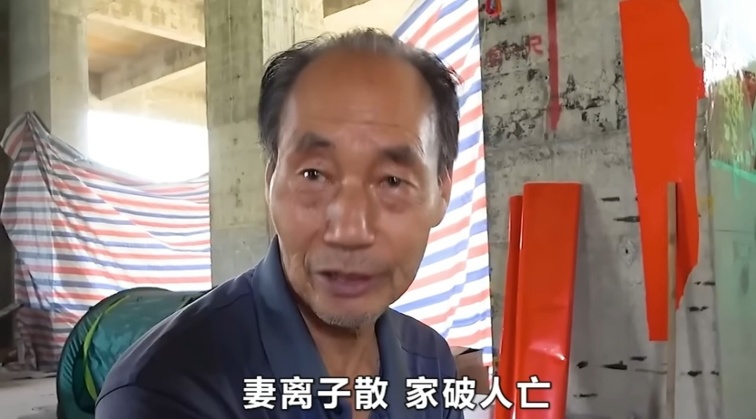
Residents of unfinished buildings express their anguish: To buy a home, we have lost everything, our marriages have crumbled, and our families have been shattered. (Video screenshot)
The harsh reality: a legalized 'Ponzi scheme'
Ultimately, it has become clear that the pre-sale real estate system that has operated in China for the past few decades is fundamentally a 'legalized Ponzi scheme' backed by the system and unprecedented in scale!
In a traditional Ponzi scheme, 'the money from later investors' is used to pay 'interest to earlier investors'; in contrast, China's pre-sale housing uses 'the pre-sale funds from later homebuyers' to cover 'the funding gaps of previous projects' and 'the costs of acquiring new land'.
Within this Ponzi framework: local governments take over 50% of land transfer fees and taxes, construct high-rise buildings, repay debts, and then wash their hands of the matter, claiming it is simply market behavior;
Real estate developers cash out the pre-sale funds and shift their assets, ultimately declaring bankruptcy and neglecting their responsibilities;
Banks reap substantial interest, and even if the properties remain unfinished, they can continue to pursue loan repayments based on contracts and label the victims as untrustworthy individuals.
The most vulnerable homebuyers have drained the wallets of three generations, only to receive a worthless check in return. They not only failed to secure a home but also face the burden of debt for the next 30 to 40 years.
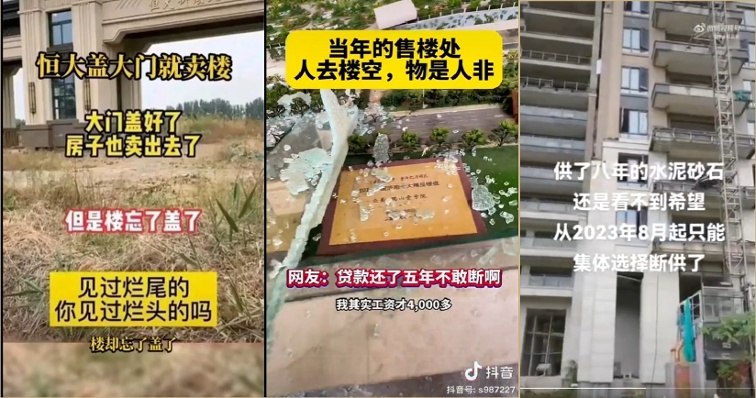
Victims of unfinished buildings see no hope and have stopped their mortgage payments altogether. (Video composite image)
Once the scam is uncovered, the game is over.
Any Ponzi scheme is destined to collapse if there are no new participants to take over.
Initially, local governments, real estate companies, and banks conspired to throw a grand party, but ultimately, it was the poorest homebuyers who bore the brunt of the costs. Now, this 'Ponzi game' has been fully recognized by the people of China.
For decades, regardless of the economic challenges faced, the authorities could easily extract the savings of the public by turning on the printing press, loosening loan restrictions, and having the propaganda machine proclaim that 'housing prices will never fall.' This allowed them to continue providing financial support to 'land finance.'
However, this time is entirely different. For the first time, the authorities have realized that financial tools have failed, the propaganda machine is malfunctioning, and even the last remnants of 'trust' have been completely exhausted. When all the 'leeks' in China choose to collectively lie flat, firmly refusing to borrow or buy homes, this Ponzi system that has operated for twenty years has hit a wall.
To be frank, the Chinese Communist authorities have never been this anxious!
Regardless of what measures the government introduces now, such as 'extending loans to 40 years' or 'selling existing homes', the public's attitude has shifted to 'borrow less, save more, and firmly refuse to buy a house', rejecting the role of the 'sucker' who takes the hit. With no more gullible individuals willing to unconditionally trust the Communist Party and the government and spend money to enter the market, the real estate myth that has persisted for twenty years is destined to end in a relentless decline, leading to a dismal conclusion.
(First published by People News)
△






News magazine bootstrap themes!
I like this themes, fast loading and look profesional
Thank you Carlos!
You're welcome!
Please support me with give positive rating!
Yes Sure!