

An increasing number of young people in China are turning to incense burning and prayer to relieve the pressures of life and work, placing their hopes in deities. (Video screenshot)
[People News] The low birth rate in China is no longer a surprise. Various statistics show that the decline in the birth population has reached alarming levels, and the country's demographic structure is undergoing an unprecedented and rapid transformation.
Life in 2026 is projected to be worse than in 1964.
According to official data from the Communist Party of China, the number of births fell to 9.56 million in 2022, marking the first time since the establishment of the Communist Party in 1949 that the figure dropped below 10 million. In 2023, the number of births further decreased to 9.02 million, setting a new historical low. By 2025, the total number of births in China is expected to be only 7.92 million, the lowest since 1949. Concurrently, the total national population has decreased to 1.4489 billion, a drop of 3.39 million from the previous year, indicating four consecutive years of negative population growth.
Demographers in China, including Lu Jiehua and Liang Zhongtang, generally estimate that the total fertility rate (TFR), which represents the average number of children a woman has, has fallen to between 0.7 and 1.0, significantly below the replacement level of 2.1 required to maintain population stability.
Reflecting on 1964, newborns in China represented as much as 27.3% of the global total, meaning that one in every four newborns was from China. However, in recent years, the proportion of Chinese newborns has dropped below one-tenth, indicating that after more than 70 years of Communist Party rule, the lives of the Chinese people are not improving; in fact, the current living conditions are perceived to be worse than those in the materially deprived year of 1964.
Many commentators highlight that the authoritarian regime of the Communist Party has stifled economic growth and restricted freedom of thought. This has placed immense pressure on the younger generation in China, who are struggling for survival. Their spirits are unable to find relief, and the pressure has no outlet, leading them to adopt a 'lying flat' approach to cope with their disheartening living conditions. As a result, their attitudes towards marriage and childbirth have changed significantly, contributing to a sharp decline in the birth rate in recent years.
Many young netizens openly share that their reluctance to have children is rooted in a desire to spare their descendants from the suffering they have experienced. The Communist Party has brought only despair to the Chinese populace.
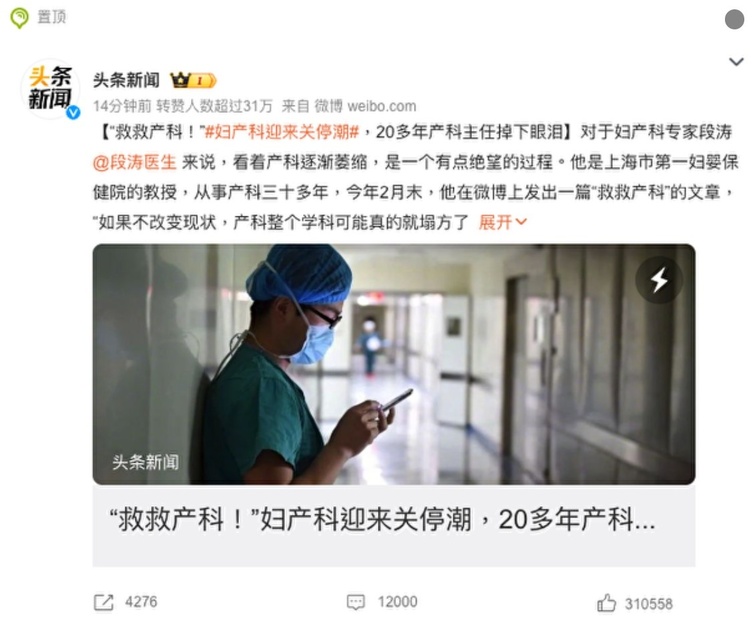
The declining birth rate in China has left many hospitals' obstetrics and gynaecology departments quite empty, with some facing closure. (Internet screenshot)
An unrealistic 'fertility-friendly society'
Recently, during the two sessions of the Communist Party, Premier Li Qiang proposed the establishment of a 'fertility-friendly society' in his report, along with accelerating the promotion of the 'silver economy.' Will such slogans inspire the younger generation to form families and reignite their enthusiasm for having children?
In an effort to reverse the declining population trend, Beijing has introduced a range of measures, including cash subsidies, childcare services, housing support, and medical insurance. The policy specifies that families with children under three years old will receive an annual subsidy of approximately 3,600 yuan per child, with the central government investing around 90 billion yuan.
However, netizens have reacted by saying, "A subsidy of 3,600 yuan barely covers a few months' worth of diaper expenses. If housing prices and the burden of education remain unchanged, no amount of vouchers will do more than provide psychological comfort."
Currently, about 33 million households in China are receiving childcare subsidies, yet the overall birth rate continues to decline. In 2022, the number of births fell below 10 million, and projections indicate it could drop to around 7 million by 2025.
Discussions on Weibo reveal that young netizens are largely indifferent to the government's commitment to "zero out-of-pocket costs for childbirth" and the inclusion of IVF (in vitro fertilisation) in medical insurance. They argue that while they can afford to give birth, they cannot afford to raise children; the high cost of living is the primary concern. This indicates that the Chinese Communist Party's vision of a "family-friendly society" fails to address the real challenges that deter people from having children, reflecting a significant disconnect from reality in the new "Chinese Dream."
Moreover, university students have strongly opposed the suggestion to introduce "marriage and childbirth education" into campuses. Most comments suggest that the competition for jobs and the pressure to survive after graduation are the main barriers to marriage and childbirth, rather than a lack of education.
Female netizens are particularly worried about "employment protection," expressing concerns that childbirth subsidies might lead companies to be more inclined to avoid hiring women.
Wang He, a Chinese expert, believes that the subsidies provided by the authorities are unlikely to change people's willingness to have children. He stated candidly, 'In reality, raising a child in China until the age of 18 requires over a million yuan in living expenses, and after three years, the subsidy is only 10,000 yuan. Therefore, this subsidy is merely a drop in the bucket.'
Professor Sun Guoxiang from National Sun Yat-sen University also noted that Beijing considers the population issue as both an economic and strategic challenge, but the effectiveness of related policies is limited. He analysed that the real challenges stem from structural issues, including 'weak income expectations, high costs of housing and education, unstable employment, late marriages, and a decline in the number of marriages.' Consequently, 'policies encouraging childbirth can typically only delay population decline, making it difficult to reverse the trend.'
The economic engine is now focused on the elderly market.
According to the Chinese Communist Party's '14th Five-Year Plan for the Development of Human Resources and Social Security' and official data from the National Bureau of Statistics, 2025 marks a critical year for China as it enters the 'largest retirement wave in history.' In light of the ageing population trend, the Communist authorities view the elderly market as a new economic engine. Official policies propose the development of the 'silver economy,' which encompasses elderly care services, healthcare, financial services for the elderly, smart elderly care, and the tourism industry.
Forecasts from the State Council of the Communist Party, the National Information Centre, and recent official media indicate that the scale of China's silver economy is expected to reach nearly 10 trillion yuan by 2025, accounting for about 6% of GDP. By 2035, it is projected to reach 30 trillion yuan, making up approximately 10% of GDP.
Officials have noted that the current share of China's silver economy in GDP has considerable room for growth compared to developed countries, with Japan's share being approximately 24%.
Experts are sceptical about the government's strategy of relying on the elderly market as a driver for economic revitalisation.
Sun Guoxiang stated that promoting the silver economy serves two purposes: 'First, it is a defensive strategy to address the rapid ageing of the population; second, it is an offensive strategy aimed at transforming ageing into a new area of consumption and a new economic engine.' However, if most elderly individuals have limited incomes, the market potential will be constrained: 'The Beijing authorities are essentially counting on mobilising the consumption power of more affluent seniors, but this approach cannot fundamentally resolve the widespread issues surrounding elderly security.' 'By 2025, China is expected to have around 320 million retirees, of which 180 million will be rural residents receiving pensions, with their monthly pension income averaging around 200 yuan or more.'
Over half of the elderly population in China receives a monthly pension of only about 200 yuan. With the Chinese Communist Party pinning its hopes for economic revitalisation on these seniors, it is no surprise that young people in China remark, 'From now on, I kneel in the temple of wealth and cannot rise.' △







News magazine bootstrap themes!
I like this themes, fast loading and look profesional
Thank you Carlos!
You're welcome!
Please support me with give positive rating!
Yes Sure!