

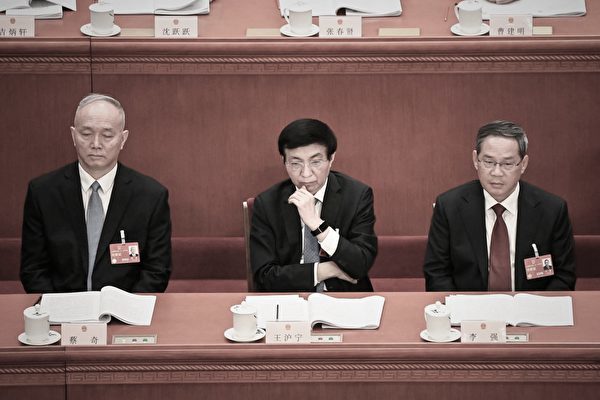
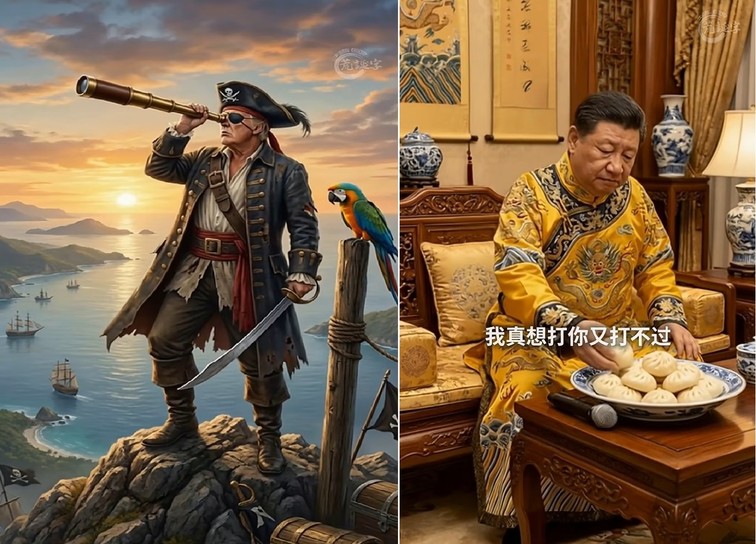
The persecution has led to a backlash, resulting in a loss of power, and those in high positions are merely playing supporting roles. (Illustration by People News)
[People News] On April 23, the party media Xinhua News Agency reported that Xi Jinping recently issued significant directives, stating that Yiwu's small commodities have successfully entered large markets and evolved into a major industry. He stressed the importance of integrating the establishment and practice of a correct view of political achievements with educational initiatives, further summarising and applying the 'Yiwu development experience' to guide various regions in exploring high-quality development paths that suit their specific circumstances.
The Xinhua report appears quite impressive, but what exactly is this view of political achievements? What do we mean by large markets and significant industries, and what constitutes a path of high-quality development? Didn't the National Bureau of Statistics just announce a GDP growth of 5% for the first quarter? Why is Xi Jinping suddenly in such a rush, unable to find a chamber pot, and resorting to Yiwu, a place he frequently researched during his early years in Zhejiang, as a makeshift solution?
Is the Yiwu experience a panacea? Can it directly address the nationwide weakness in domestic demand? Can it replace real estate as a pillar industry? The call to 'promote the Yiwu experience' carries a sense of urgency in the current context of China's economic downturn. Xi Jinping has adopted it as a new source of policy inspiration, but it resembles a hasty attempt to find a cure for a problem. Local governments should be cautious; if they heed this advice, they risk ending up with incomplete projects.
Is it really possible to solve China's economic issues by borrowing a county-level foreign trade model and employing top-level deception to create a nationwide promotion model? This notion is reminiscent of the series of economic fairy tales told by Xi Jinping, which suggest that Xiong'an can be developed into a city for the ages. The very fact that such a misguided idea was proposed highlights the stark reality of China's economic situation: sluggish domestic demand, pressure on private enterprises, declining investments, a deflationary spiral, and weakening expectations. Can simply saying 'let's replicate Yiwu' truly be a panacea?
Let's first examine the broader context. By 2025, China's total retail sales of consumer goods are projected to reach 50.1202 trillion yuan, reflecting a year-on-year growth of 3.7%, which lags behind GDP growth by 1.3 percentage points. Concurrently, national fixed asset investment (excluding rural households) is expected to be 48.5186 trillion yuan, marking a year-on-year decline of 3.8%, with private fixed asset investment decreasing by 6.4%. Both consumption and investment, the two key drivers of economic growth, are facing significant challenges.
In this context, Yiwu stands out remarkably. By 2025, Yiwu's import and export volume is anticipated to surpass 800 billion yuan for the first time, reaching 836.5 billion yuan, a year-on-year increase of 25.1%; of this, exports are expected to be 730.7 billion yuan and imports 105.8 billion yuan, growing by 24.1% and 32.3% respectively. Yiwu engages in trade with 231 countries and regions, with 156 of them having trade volumes exceeding 100 million yuan, and the growth rates of imports and exports to emerging markets such as Africa, Latin America, and ASEAN are particularly noteworthy.
What does Yiwu rely on? It is built on the long-term accumulation of market density, supply chain efficiency, and transaction convenience, alongside the strong purchasing power of Europe and the United States and an inclusive and open external environment. Yiwu's success does not stem from any grand missions or political narratives assigned to it, but rather from its unwavering focus on the concept of 'transaction.' It serves as a distribution hub for small commodities, a trading venue for small and medium-sized businesses, and has prospered through foreign trade orders and global mid-to-low-end consumption. Its operational logic has never been about government leadership, government investment, or a unified large-scale supply and marketing system; instead, it is rooted in free markets and free trade. This is not a model that can be easily replicated through political rhetoric.
The government's role is primarily to create platforms, improve infrastructure, eliminate barriers, change regulations, and facilitate business operations. This model is effective because it aligns with market principles rather than attempting to impose political narratives over market dynamics. Thus, the most valuable lesson from the Yiwu experience is not 'how to create a template,' but rather 'how to lower transaction costs, stimulate grassroots vitality, and allow small and medium-sized entities to grow freely.' In essence, the key factor that enables Yiwu to become the 'world supermarket' is allowing the government to take a backseat, as Li Qiang once stated, letting the government act as a shop assistant.
Today, Xi Jinping personally promoted the Yiwu experience, not as a means to address issues, but rather to sidestep contradictions. Since Xi took office, economic development has been entirely subordinate to political logic. His goal is to 'strengthen, optimise, and expand state-owned capital and state-owned enterprises.' State-owned enterprises have consistently been positioned at the strategic core, while private enterprises have been increasingly squeezed, marginalised, and absorbed. Private entrepreneurs have faced confiscation of their assets, robbery, capture at sea, and imprisonment for alleged crimes; this reflects Xi Jinping's fundamental view of political achievements. The latest judicial interpretation from the Supreme People's Court and the Supreme People's Procuratorate indicates that a private enterprise owner withdrawing 30,000 yuan from their own company is deemed a criminal act. This not only provides direction for private enterprises but also formally establishes, through institutional means, that what is mine is mine, and what is yours is also mine.
The current state of the Chinese economy, under Xi Jinping's tumultuous rule for over a decade, is severely battered. Despite successive waves of stimulus policies, the reality remains harsh. Consumer spending has been stagnant for a long time, private investment is lacking enthusiasm, local fiscal debts are overwhelming, the real estate market continues to weigh down the economy, and the external environment has become increasingly complex. As economic pressures mount, domestic demand falters, and private enterprises become hollowed out, exports emerge as the last resort. At this juncture, Xi Jinping is compelled to look back and seek the source of market vitality, once again bringing private enterprises and the Yiwu experience to the forefront to fill the void. This resembles the act of making a large pancake, but more closely resembles searching for a night pot.
In this context, the renewed emphasis on Yiwu appears particularly ironic and amusing. Yiwu is one of China's most representative private trade cities focused on foreign trade. Its core advantage does not stem from policy proclamations or directives from leaders, but rather from a long-standing development of market mechanisms. In other words, Yiwu's ability to continue contributing to China's economic growth is not due to meticulous planning handed over to the government, but because it enables thousands of ordinary operators to work without being hindered by administrative interference. The greatest strength of Yiwu lies not in the strict management of enterprises, but in minimising the obstacles that businesses fear the most when engaging in trade. Essentially, its experience is about 'allowing space for private vitality.' In other words, it reflects a 'de-Xi Jinping-ization' approach.
Even though the Yiwu model represents a global supermarket model, it is not suitable for replication in other regions governed by the Chinese Communist Party for two reasons:
Firstly, Yiwu's challenges amid a sluggish global economy and tariff blockades are very real. Fluctuations in orders, profit compression, and inventory pressures are occurring in succession, with orders for Yiwu's small commodities projected to decrease by 10%-20% by 2025. Tariff blockades have increased costs, leading to profit reductions of 5%-15% in certain categories. The share of orders from the U.S. market has dropped to just 14%, while exports to the EU have decreased by 11%. The proportion of Yiwu's exports to Europe and the U.S. has fallen from a peak of 30% to around 20%, with direct reliance on U.S. merchants at only 3%. Many merchants are being forced to pivot towards the 'Belt and Road Initiative' and ASEAN for relief.
Secondly, the Yiwu model resembles a 'lame duck'; while the foreign trade supply chain is robust, the leg of domestic demand transformation is severely impaired, making it nearly impossible to achieve a conversion to domestic demand. Yiwu's products are predominantly mid-to-low-end, making them highly replaceable. Additionally, toys and accessories yield low profit margins, exhibit weak risk resistance, and face challenges in upgrading to high-end products, resulting in low added value. They are highly sensitive to economic cycles, with holiday orders constituting a significant portion; thus, in the event of an economic downturn, the likelihood of being adversely affected is exceedingly high.
In other words, the threshold for the Yiwu manufacturing miracle is quite high, and the boundary factors are complex. Not only is it challenging for other regions to replicate this model, but there are also insufficient conditions for transitioning to domestic demand, and the number of jobs created is very limited, primarily catering to migrant workers. Yiwu fundamentally cannot address the root issue of the Chinese Communist Party's weak domestic demand in the economy.
As for promoting the Yiwu experience, Xi Jinping's database of unfinished projects is bound to expand.
(First published in People News)△




News magazine bootstrap themes!
I like this themes, fast loading and look profesional
Thank you Carlos!
You're welcome!
Please support me with give positive rating!
Yes Sure!